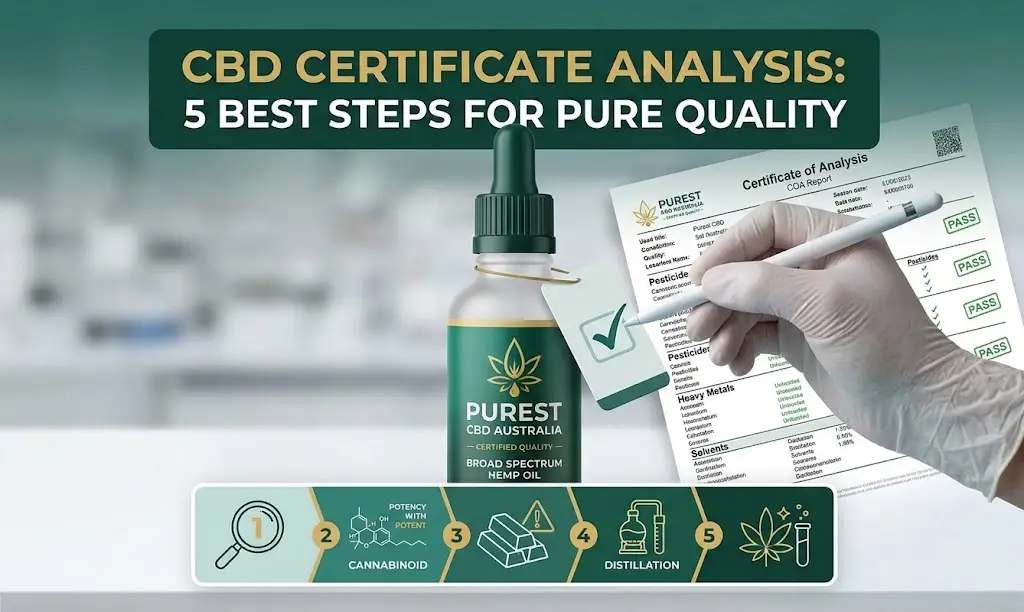
Understanding product verification is essential for Australian consumers evaluating broad-spectrum hemp formulations. Performing a thorough CBD Certificate Analysis allows buyers, retailers, and health professionals to verify batch safety, cannabinoid concentration, and third-party laboratory integrity. As consumer interest in botanical supplements continues to expand, knowing how to interpret independent testing documentation provides a transparent foundation for evaluating product standards.
A Certificate of Analysis (COA) serves as an official document issued by an accredited testing facility. It outlines the chemical composition of a specific product batch, detailing cannabinoid levels and verifying the absence of undesirable contaminants. This educational guide breaks down the critical components of laboratory testing to help you evaluate documentation with clarity and confidence.
Why CBD Certificate Analysis Is Essential for Consumer Trust
Independent laboratory testing is the gold standard for quality assurance in the cannabinoid industry. Because raw agricultural hemp absorbs compounds directly from the soil in which it is grown, rigorous testing protocols ensure that final consumer products maintain exceptional quality and consistency.
When performing a CBD Certificate Analysis, the primary objective is to confirm that the physical contents of the bottle match the specifications declared on the packaging. Analytical laboratories operating under ISO/IEC 17025 accreditation utilize advanced testing methods, such as High-Performance Liquid Chromatography (HPLC) and Gas Chromatography-Mass Spectrometry (GC-MS), to deliver precise metric breakdowns.
In Australia, regulatory frameworks overseen by bodies like the Therapeutic Goods Administration (TGA) emphasize strict quality controls, standardized manufacturing practices, and clear analytical verification for health and botanical products. Reviewing a third-party laboratory report ensures complete operational transparency from farm to finished product.
5 Key Steps to Complete a CBD Certificate Analysis
Navigating a multi-page laboratory report can appear complex at first glance. Following a structured evaluation process makes it simple to verify every critical measurement:
1. Verify Laboratory Accreditation and Batch Matching for CBD Certificate Analysis
Start by confirming that the document originates from an independent, accredited third-party facility rather than an in-house manufacturer laboratory. Check that the batch number printed on the laboratory certificate corresponds exactly to the batch or lot code on your product packaging. Additionally, check the test date to ensure the analysis reflects recent production batches.
2. Inspect the Cannabinoid Profile and Potency Ratings
The cannabinoid profile section lists the individual concentrations of active compounds expressed in milligrams per gram (mg/g) or total milligrams per bottle. Key cannabinoids to review include:
- Cannabidiol (CBD): The primary non-intoxicating cannabinoid. Verify that the measured potency aligns with the advertised label strength.
- Minor Cannabinoids: Compounds such as Cannabigerol (CBG), Cannabinol (CBN), and Cannabichromene (CBC), which contribute to broad-spectrum profiles.
- Tetrahydrocannabinol (THC): Confirm that THC levels fall below detectable thresholds or statutory limits for non-intoxicating hemp products.
3. Review Heavy Metal Screenings
Hemp plants naturally act as bioaccumulators, absorbing minerals and substances from cultivation soil. A comprehensive CBD Certificate Analysis includes Inductively Coupled Plasma Mass Spectrometry (ICP-MS) testing for heavy metals such as lead, cadmium, arsenic, and mercury. Confirm that all tested metals fall safely below established limits of quantification (LOQ).
4. Check Residual Solvent Clearances
Clean extraction methodologies—such as supercritical CO2 extraction—are designed to leave zero toxic residues. Clean extraction standards evaluated during a CBD Certificate Analysis verify that volatile organic compounds like ethanol, butane, or propane used during processing have been completely removed during purification. The document should explicitly state a “Pass” status across all solvent panels.
5. Examine Pesticide and Microbial Panels
Finally, inspect the microbiological and agricultural chemical panels. The analysis should confirm the complete absence of harmful pesticides, herbicides, fungicides, mycotoxins, mold, yeast, and bacterial contaminants like E. coli or Salmonella.
Understanding Cannabinoid Profiles and THC Thresholds
When reviewing analytical reports, distinguishing between product categories relies heavily on the cannabinoid profile breakdown:
| Extract Profile | Cannabinoid Content | THC Verification |
|---|---|---|
| Broad-Spectrum | Multiple cannabinoids & terpenes | Non-detectable / Zero THC |
| Isolate | Pure CBD (>99%) only | 0.00% THC |
| Full-Spectrum | Full plant cannabinoid matrix | Trace THC (<0.3% or compliant) |
For additional educational resources regarding cannabinoid testing standards and plant science, explore our Purest CBD Australia Blog and our dedicated Quality & Testing collection.
Frequently Asked Questions About CBD Certificate Analysis
What is a Certificate of Analysis (COA) in CBD testing?
A Certificate of Analysis is an official report issued by an independent laboratory detailing the exact cannabinoid concentration, purity, and safety screening results for a specific batch of hemp extract.
How do I match a COA to the bottle I purchased?
Locate the batch or lot number printed on the product bottle or box, then check that the identical batch number is listed at the top of the Certificate of Analysis document.
What does “ND” mean on a laboratory analysis report?
On a testing report, “ND” stands for “Not Detected.” It indicates that the target substance (such as THC, heavy metals, or residual solvents) was below the limit of detection for the testing equipment.
In summary, mastering a CBD Certificate Analysis empowers consumers to evaluate product safety and potency with complete autonomy. By checking third-party laboratory credentials, matching batch codes, and reviewing purity screenings, you can ensure that every broad-spectrum formulation meets the highest standard of quality.
Recent Comments