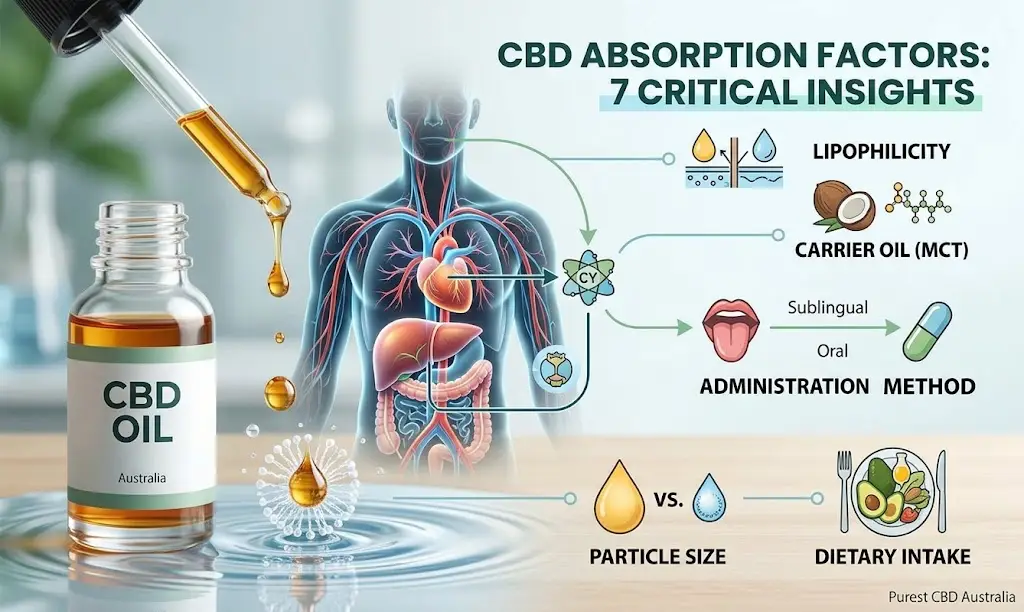
Understanding CBD absorption factors is an essential component of navigating hemp-derived cannabinoid education in Australia. When exploring botanical compounds, consumers and industry professionals alike frequently examine how non-intoxicating hemp extract interacts with the body’s physiological pathways. Because natural cannabinoids are lipophilic (fat-soluble) molecules, their rate and degree of uptake depend on several biological and formulation variables. In this complete guide, we examine the primary determinants that influence how broad-spectrum extracts are processed, providing neutral, evidence-informed insights into cannabinoid chemistry and administration protocols.
Understanding CBD Absorption Factors in Cannabinoid Education
In the field of plant science, bioavailability refers to the fraction of an active constituent that enters systemic circulation unchanged to exert a physiological presence. For plant-derived cannabinoids such as cannabidiol (CBD), achieving optimal stability and systemic entry requires addressing significant biochemical barriers. Primary among these is the molecule’s hydrophobic nature, which prevents rapid dissolution in water-based environments like the human bloodstream. By analysing key CBD absorption factors, individuals can better evaluate product labels, formulation types, and laboratory certificates of analysis.
1. Lipophilic Characteristics of Plant-Derived Cannabinoids
Cannabinoids produced within the glandular trichomes of industrial hemp (Cannabis sativa L.) are inherently hydrophobic and lipophilic. This chemical structure means that CBD molecules dissolve readily in lipids and fats rather than aqueous liquids. When unformulated raw extracts are ingested without a lipid carrier, physiological uptake remains relatively modest. Understanding lipophilicity is fundamental to appreciating why high-grade hemp preparations are meticulously infused into botanical carrier oils to facilitate efficient uptake through digestive membranes.
2. Carrier Oil Composition and Lipid Solubility
The type of carrier oil selected during manufacturing plays a pivotal role among CBD absorption factors. Medium-chain triglyceride (MCT) coconut oil and hemp seed oil are two of the most popular carrier bases utilised in premium Australian formulations. MCT oil contains medium-chain fatty acids that are quickly processed by the liver, acting as a direct lipid transport vehicle. Hemp seed oil offers a natural omega-fatty acid profile that complements the botanical origin of the extract. The choice of carrier lipid directly affects lipid digestion pathways, micelle formation, and overall compound transport.
3. First-Pass Metabolism in Oral Formulations
When cannabinoids are ingested orally via capsules or ingested liquids, they pass through the stomach and enter the gastrointestinal tract before reaching the liver via the portal vein. This journey triggers a biological process known as first-pass hepatic metabolism. During first-pass metabolism, liver enzymes (specifically cytochrome P450 enzymes) metabolise a portion of the ingested CBD into secondary metabolites, altering its chemical structure before reaching systemic circulation. Sublingual administration—holding oil droplets beneath the tongue before swallowing—allows direct uptake through the mucosal membrane, partially bypassing hepatic first-pass degradation.
4. Particle Size and Emulsification Technologies
Modern botanical processing techniques have introduced advanced emulsification strategies to enhance compound dispersibility. Methods such as nanoemulsification and liposomal delivery reduce cannabinoid droplet sizes down to the nanometer scale. By creating self-emulsifying delivery systems, manufacturers increase the surface area available for enzymatic interaction during digestion. Smaller droplet sizes facilitate more rapid formation of mixed micelles in the small intestine, leading to smoother mucosal transit and enhanced biochemical delivery.
5. Dietary Intake and Timing Considerations
Physiological uptake of oral hemp extracts is significantly influenced by co-ingestion with dietary fats. Consuming hemp-derived products alongside a light meal containing healthy lipids (such as avocados, nuts, or healthy plant oils) stimulates bile secretion and pancreatic lipase activity. Bile salts emulsify dietary fats alongside lipophilic cannabinoids, forming micelles that transport active compounds across the intestinal epithelium. Research consistently demonstrates that taking broad-spectrum extracts with lipid-rich foods enhances total compound availability compared to administration on an empty stomach.
6. Botanical Profile and Entourage Dynamics
Broad-spectrum extracts contain an array of naturally occurring minor cannabinoids, terpenes, and flavonoids alongside CBD, while completely removing detectable delta-9-THC. The synergy between these naturally occurring phytocompounds is commonly referred to in botanical science as the entourage effect. Terpenes such as beta-caryophyllene, myrcene, and limonene not only contribute natural aromas but may also influence membrane permeability and compound stability. Selecting whole-plant or broad-spectrum profiles preserves these botanical interactions compared to isolated synthetic molecules.
7. Product Storage and Compound Stability
Environmental exposure to light, oxygen, elevated temperatures, and moisture can degrade active cannabinoids over time, directly impairing product consistency and performance. Oxidation converts cannabidiol into minor degradation products, altering the potency indicated on product labels. Storing formulations in amber glass bottles, keeping containers sealed tightly, and maintaining storage environments below 25°C preserve molecular integrity. Checking Third-Party Certificates of Analysis (COAs) ensures that products maintain verified active constituent profiles across their shelf life.
Evaluating CBD Absorption Factors for Quality Standards
Evaluating these CBD absorption factors allows Australian consumers to make well-informed decisions when reviewing educational resources and product specifications. Premium quality control involves independent laboratory testing, precise labelling of active ingredients, and rigorous compliance with Australian standards. For further details on national regulatory frameworks governing therapeutic goods and cannabinoid research in Australia, visit the official Therapeutic Goods Administration (TGA) website. To explore additional educational topics and botanical guides, visit the Purest CBD Australia Blog.
Frequently Asked Questions About CBD Absorption Factors
What is the most significant factor influencing CBD absorption?
The primary factor is the lipophilic (fat-soluble) nature of cannabinoids. Because CBD dissolves in lipids rather than water, combining hemp extracts with quality carrier oils like MCT oil or consuming them alongside dietary fats significantly enhances uptake.
How does sublingual administration differ from ingestion?
Sublingual administration involves holding oil under the tongue, allowing compounds to absorb through the oral mucosal membranes directly into systemic circulation. Ingestion requires digestive transit and hepatic first-pass metabolism, which alters a portion of the active compounds before systemic distribution.
Why are carrier oils used in CBD formulations?
Carrier oils serve as a lipid vehicle necessary for dissolving hydrophobic hemp extracts. They protect cannabinoids from premature degradation, facilitate micelle formation in the digestive tract, and ensure consistent dosing across liquid preparations.
Recent Comments