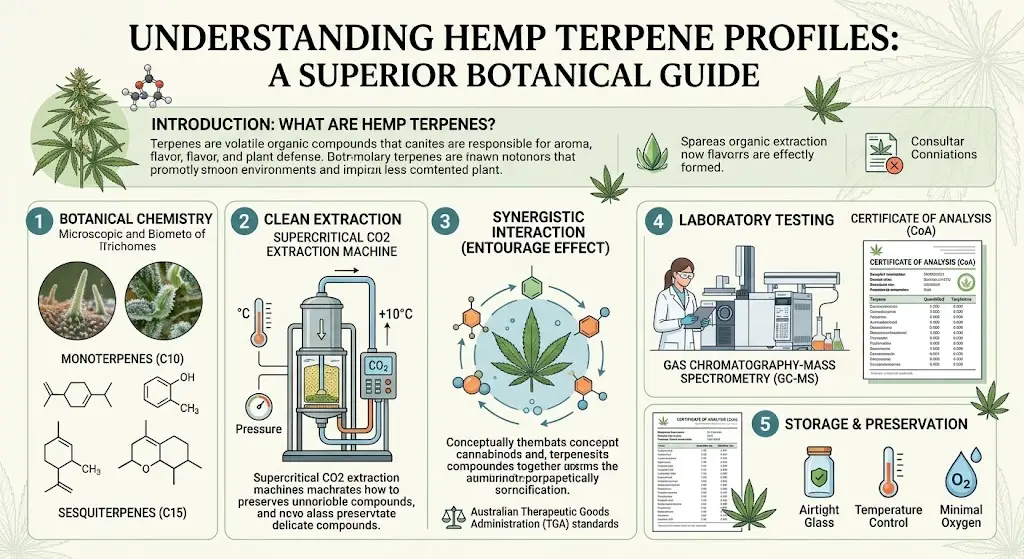
Hemp Terpene Profiles represent one of the most fascinating areas of modern botanical science, providing deep insight into the intricate chemistry of industrial hemp (Cannabis sativa L.). These volatile organic compounds are responsible for the distinctive aromatic qualities, flavour nuances, and complex phytochemical characteristics of raw hemp biomass. Beyond their sensory contribution, terpenes interact alongside broad-spectrum phytocannabinoids to define the overall botanical fingerprint of legal hemp extracts. Understanding how these compounds are synthesised, preserved through clean extraction, and verified via laboratory testing is essential for anyone interested in high-quality plant science. For a broader overview of cannabinoid science, explore our recent articles on the Purest CBD Australia blog.
1. Understanding Hemp Terpene Profiles and Botanical Chemistry
In plant physiology, terpenes are secondary metabolites produced within specialised glandular trichomes located primarily on the flowering tops and leaves of female hemp plants. The biological role of these aromatic hydrocarbons is primarily defensive, protecting the crop against herbivorous insects, microbial pathogens, and excessive ultraviolet radiation. From a molecular perspective, hemp terpenes are predominantly classified into two main structural categories based on their carbon counts:
- Monoterpenes: Small, highly volatile molecules comprising two isoprene units ($C_{10}H_{16}$). Prominent examples include myrcene (earthy, herbal aroma), alpha-pinene (fresh pine scent), and limonene (bright citrus fragrance). Due to their low boiling points, monoterpenes evaporate rapidly during harvesting, drying, and traditional thermal extraction.
- Sesquiterpenes: Larger, heavier molecules consisting of three isoprene units ($C_{15}H_{24}$). Key examples include beta-caryophyllene (peppery, spicy aroma) and humulene (woody, hops-like scent). Sesquiterpenes possess higher boiling points and demonstrate greater thermal stability during handling.
The specific concentration and ratio of these monoterpenes and sesquiterpenes constitute the unique Hemp Terpene Profiles observed across different industrial hemp cultivars and growing seasons. Environmental factors such as soil composition, solar irradiance, irrigation schedules, and harvest timing significantly influence the final biosynthetic yield of these secondary metabolites.
2. How Clean Extraction Preserves Essential Hemp Terpene Profiles
Preserving volatile terpenes during commercial processing requires meticulous environmental control and advanced engineering. Traditional solvent-based extraction methods using heat or harsh chemical reagents often degrade or strip away delicate monoterpenes, altering the natural organoleptic qualities of the plant. Modern botanical facility practices utilise supercritical carbon dioxide ($CO_2$) extraction to safeguard sensitive phytochemical structures.
Supercritical $CO_2$ technology operates under precise temperature and pressure thresholds where carbon dioxide exhibits properties of both a gas and a liquid. By adjusting the extraction pressure (often utilising a two-phase subcritical or low-temperature supercritical process), extractors can selectively target and isolate delicate terpene compounds without scorching them. This cold-processing approach ensures that the final refined extract maintains the structural integrity of its original terpene spectrum, delivering an authentic botanical representation of the source harvest.
3. The Synergistic Interaction of Terpenes and Cannabinoids
Within plant chemistry literature, the co-existence of terpenes and non-psychoactive phytocannabinoids (such as cannabidiol, or CBD) is recognized as a defining feature of broad-spectrum plant matrixes. While phytocannabinoids interact with lipid pathways, terpenes provide distinct chemical diversity to the botanical mixture. This holistic phytochemical ensemble is often discussed in botanical science as the “entourage effect”—a term describing how multiple naturally occurring plant compounds function in unison within an extract.
In Australia, agricultural hemp cultivation and technical processing operate under strict regulatory standards established by legal bodies including the Therapeutic Goods Administration. These framework parameters ensure that industrial hemp products adhere strictly to permissible legal limits for delta-9-tetrahydrocannabinol (THC) while upholding rigorous standardisation, consistency, and chemical purity across commercial batches.
4. Laboratory Testing and Certificate of Analysis Verification
To accurately quantify Hemp Terpene Profiles, accredited analytical testing facilities employ advanced analytical instrumentation. Gas Chromatography coupled with Mass Spectrometry (GC-MS) or Flame Ionisation Detection (GC-FID) represents the gold standard for identifying individual terpene molecules and measuring their exact concentrations in parts per million (ppm) or percentage by weight.
A comprehensive Certificate of Analysis (CoA) issued by an independent ISO-accredited laboratory will detail the terpene spectrum alongside cannabinoid potency, heavy metal screening, residual solvent analysis, and pesticide testing. Checking a product’s CoA allows consumers and industry professionals to confirm that volatile compounds have been successfully preserved without thermal degradation or chemical contamination during manufacture.
5. Storage and Preservation of Aromatic Botanical Extracts
Because terpenes are inherently volatile organic compounds, maintaining their stability requires proper storage conditions. Exposure to ambient heat, atmospheric oxygen, and direct ultraviolet light accelerates oxidation and degradation, converting active terpenes into secondary oxidised byproducts that can alter taste and aroma.
To maximise shelf life and preserve compound integrity, high-terpene botanical extracts should be stored using the following practices:
- Airtight Glass Packaging: Store extracts in dark amber or cobalt blue glass containers to shield delicate compounds from light degradation while preventing gas permeability common in soft plastics.
- Temperature Control: Keep products in a cool, climate-controlled environment away from heat sources or direct sunlight. Refrigeration can further slow down volatile evaporation.
- Minimal Oxygen Exposure: Keep containers tightly sealed when not in use to minimise headroom oxidation and preserve fresh aromatic notes over extended durations.
Frequently Asked Questions About Hemp Terpene Profiles
What are hemp terpene profiles?
Hemp Terpene Profiles refer to the specific combination and percentage ratios of aromatic terpenes (such as myrcene, pinene, limonene, and caryophyllene) present within a given industrial hemp plant cultivar or botanical extract.
Do terpenes affect the aroma and flavour of hemp extracts?
Yes. Terpenes are primarily responsible for the distinctive scent and taste profiles of hemp products, ranging from earthy and herbal notes to citrus, floral, or pine flavours.
How are terpenes measured in laboratory testing?
Terpenes are measured using high-precision Gas Chromatography (GC-MS or GC-FID), which separates volatile compounds based on their boiling points and molecular mass to yield an exact breakdown in a Certificate of Analysis.
Why do terpene levels vary between plant harvests?
Terpene levels fluctuate naturally based on environmental factors, including soil nutrients, climate conditions, sun exposure, harvest timing, and post-harvest drying techniques.
In summary, evaluating Hemp Terpene Profiles offers essential visibility into the quality, natural chemistry, and processing care of botanical hemp products, ensuring high standards of purity and botanical integrity across Australian industry standards.
Recent Comments