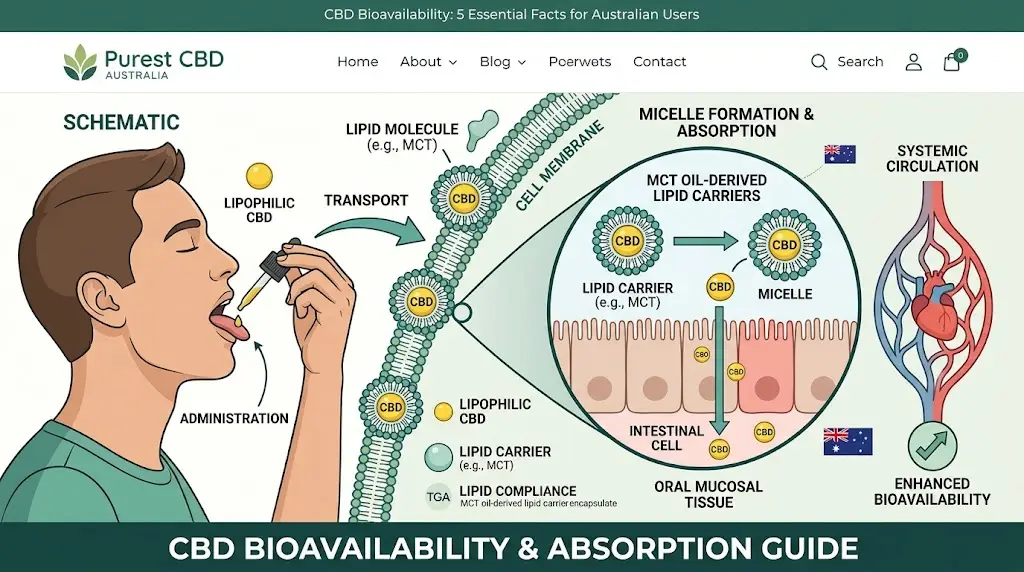
Understanding CBD Bioavailability is essential for evaluating how botanical hemp compounds interact with lipid delivery systems. When exploring broad-spectrum hemp extracts, consumers frequently encounter references to absorption rates, carrier matrices, and formulation chemistry. Bioavailability refers to the proportion of an active compound that enters systemic circulation unchanged to exert its botanical presence. Because raw phytocannabinoids are lipophilic (fat-soluble) substances, their movement through biological barriers depends heavily on the surrounding delivery vehicle, particle size, and administration format.
In Australia, evaluating product quality requires a clear understanding of physiological absorption principles alongside compliance with the Therapeutic Goods Administration (TGA) regulatory framework. By examining how different carriers and extraction methods influence phytocannabinoid transport, Australian consumers can better appreciate the botanical engineering behind modern hemp preparations available across the Purest CBD Australia blog resources.
Understanding CBD Bioavailability and Botanical Absorption
Phytocannabinoids derived from industrial hemp (Cannabis sativa) possess high lipophilicity, meaning they dissolve readily in fats but poorly in water. When an unformulated lipophilic compound is introduced without a lipid medium, its natural absorption rate remains relatively low due to limited aqueous solubility in biological fluids. Formulators overcome this inherent physical characteristic by suspending hemp extracts within specialised lipid bases such as medium-chain triglyceride (MCT) oil or hemp seed oil.
When ingested or held sublingually, the lipid vehicle encapsulates the non-polar CBD molecules, forming tiny emulsion droplets known as micelles. These micelles facilitate transport across mucous membranes or digestive epithelia, protecting the botanical compound from immediate degradation. Consequently, understanding the relationship between molecular structure and lipid carriers provides valuable insight into overall product consistency and efficiency.
5 Key Factors Influencing CBD Bioavailability
Several distinct factors dictate how effectively phytocannabinoids are processed within a given formulation matrix. Examining these five primary parameters highlights the scientific considerations involved in modern hemp extract development:
- Lipid Carrier Type: Medium-chain triglycerides (MCTs) feature shorter fatty acid carbon chains than long-chain oils, enabling faster enzymatic breakdown and enhanced micelle formation.
- Administration Format: Sublingual delivery allows direct absorption through oral mucosal tissues, bypassing initial hepatic processing, whereas ingested capsules undergo gastrointestinal breakdown.
- Particle Size & Emulsification: Advanced processing techniques, such as nano-emulsification or micro-encapsulation, reduce droplet sizes, significantly increasing total surface area for absorption.
- Presence of Minor Cannabinoids & Terpenes: Broad-spectrum extracts retain naturally occurring plant compounds that work synergistically in a botanical matrix, maintaining extract stability.
- Food & Dietary Fat Interactions: Consuming oral preparations alongside healthy dietary fats stimulates bile secretion, which enhances the solubilisation of lipophilic cannabinoids.
Evaluating Broad-Spectrum Formulations for Optimal Consistency
Broad-spectrum hemp extracts undergo targeted processing to remove detectable levels of delta-9-tetrahydrocannabinol (THC) while retaining an array of non-intoxicating phytocannabinoids, terpenes, and flavonoids. This refined compound profile presents unique advantages for formulation stability and delivery efficiency.
Quality-focused manufacturers conduct rigorous third-party laboratory testing to verify both cannabinoid potency and carrier purity. Ensuring that carrier oils remain free from oxidation and rancidity is vital, as degraded lipids can negatively impact compound stability and alter physiological absorption dynamics. Consumers reviewing an Australian CBD buying guide can verify these quality indicators through batch-specific Certificates of Analysis (COA).
Frequently Asked Questions About CBD Bioavailability
- What does bioavailability mean in relation to hemp extracts?
Bioavailability describes the percentage of phytocannabinoids that reaches systemic circulation intact following administration, determining how efficiently a botanical formulation is absorbed. - Why are carrier oils necessary for hemp formulations?
Because cannabinoids are fat-soluble (lipophilic), carrier oils like MCT or hemp seed oil create a stable lipid vehicle that allows phytocannabinoids to dissolve and form absorbable micelles. - How does sublingual administration differ from swallowing an oral capsule?
Sublingual placement allows compounds to absorb directly through the oral mucosa, whereas swallowed capsules travel through the digestive system and liver before entering circulation.
In summary, evaluating CBD Bioavailability provides a clear, science-based framework for understanding how lipid carrier selection, extraction refining, and delivery formats shape phytocannabinoid performance. By selecting transparently tested, broad-spectrum products crafted with premium carrier matrices, Australian consumers can make well-informed decisions grounded in botanical facts.
Recent Comments