Navigating the evolving landscape of hemp products requires a clear understanding of CBD Oil Terminology. As consumer interest in botanical formulations grows across Australia, interpreting labels, lab reports, and extraction definitions has become essential for informed decision-making. Whether evaluating broad-spectrum extracts or scrutinising certificates of analysis, recognizing key industry terms ensures transparency and consistency when choosing quality products.
In this guide, we explore seven fundamental terms every consumer should know to navigate product labels with confidence, making CBD Oil Terminology accessible and clear. Understanding these core concepts provides a solid foundation for evaluating quality standards and botanical integrity.
1. Broad-Spectrum vs. Isolate: Decoding CBD Oil Terminology
One of the most crucial aspects of CBD Oil Terminology is distinguishing between different extract types. Broad-spectrum extracts contain a variety of naturally occurring hemp compounds, such as minor cannabinoids and terpenes, while deliberately excluding detectable levels of tetrahydrocannabinol (THC). This profile allows users to access complementary plant compounds working together seamlessly.
In contrast, an isolate consists of refined cannabidiol isolated from all other plant matter, yielding a pure crystalline structure. Understanding this distinction helps consumers identify which formulation aligns with their specific preferences and product expectations without confusion.
2. The Role of Cannabinoids and Terpenes
Hemp plants contain over one hundred naturally occurring cannabinoids alongside aromatic compounds known as terpenes. Terpenes give botanical extracts their characteristic aroma and flavor profiles, ranging from earthy pine to fresh citrus notes. When examining product documentation, mastering CBD Oil Terminology surrounding cannabinoids and terpenes offers insight into the plant’s natural botanical profile.
Cannabinoids interact with plant-derived receptors, and reviewing complete compound breakdowns ensures that product specifications match official manufacturing documentation accurately.
3. Certificate of Analysis (COA) and Quality Assurance
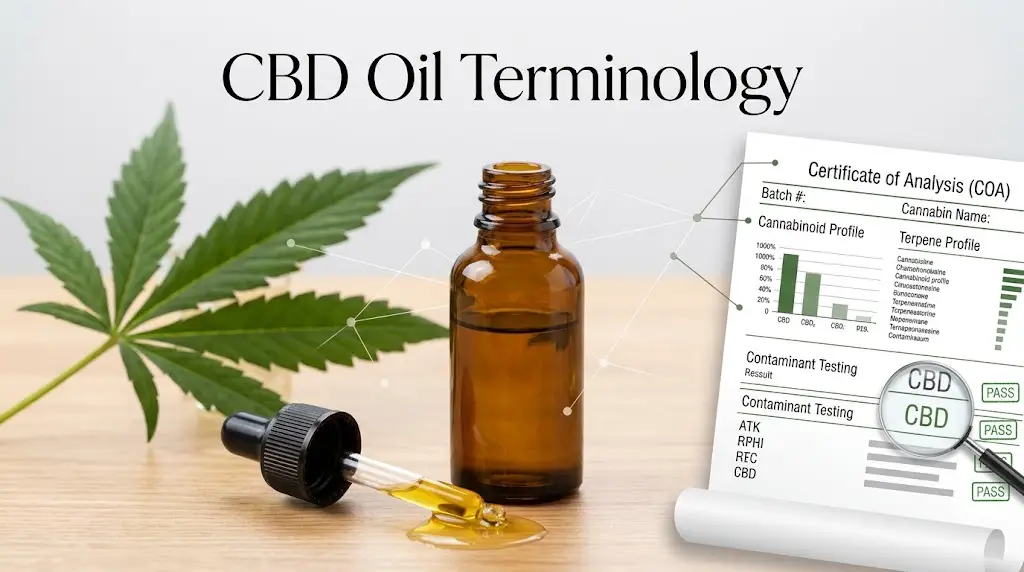
In terms of quality control and CBD Oil Terminology, a Certificate of Analysis (COA) is an independent laboratory report verifying the composition, potency, and purity of a product batch. Independent analytical testing confirms cannabinoid concentrations and checks for contaminants such as heavy metals, residual solvents, pesticides, and microbials. Reputable manufacturers publish third-party batch test results openly to ensure full regulatory compliance and consumer trust.
According to guidelines established by regulatory bodies such as the Therapeutic Goods Administration (TGA), maintaining strict quality control and batch tracking is fundamental for product safety in Australia. Reviewing a COA allows buyers to verify that label claims correspond directly to verified laboratory data.
4. Carrier Oils: MCT, Hemp Seed, and Olive Oil
Understanding CBD Oil Terminology regarding carrier oils is equally essential, as CBD extract is naturally fat-soluble, meaning it requires a carrier oil for stability and consistent measuring. Common carrier oils include Medium-Chain Triglyceride (MCT) oil—derived from coconut or palm oil—hemp seed oil, and cold-pressed olive oil. Each carrier oil offers distinct properties:
- MCT Oil: Highly stable with a neutral taste and light texture, making it popular for daily liquid drops.
- Hemp Seed Oil: Rich in essential fatty acids (Omega-3 and Omega-6), offering a nutty flavor profile directly from the hemp seed.
- Olive Oil: A traditional option providing smooth texture and mild botanical notes.
5. Milligram Potency and Concentration Metrics
Understanding concentration metrics and CBD Oil Terminology is vital when reading product labels. Labels typically display two primary numbers: the total milligrams (mg) of CBD in the entire bottle and the liquid volume in millilitres (mL). Calculating the concentration per millilitre (mg/mL) provides a standardized metric for comparing different bottle sizes and formulations accurately.
For example, a 30 mL bottle containing 1500 mg of CBD delivers a concentration of 50 mg/mL. Standardising these calculations prevents confusion when switching between different bottle capacities or serving tools.
6. Extraction Methods: Supercritical CO2 vs. Ethanol
Analyzing CBD Oil Terminology for extraction methods helps clarify how cannabinoids are separated from industrial hemp, which significantly impacts the final product’s purity profile. Supercritical CO2 extraction utilizes pressurized carbon dioxide to gently pull cannabinoids and terpenes from plant material without requiring harsh chemical solvents or high thermal stress. This precise technique yields a clean, high-grade extract free from solvent residues.
Ethanol extraction is another widespread methodology, suitable for processing larger volumes while preserving a robust botanical profile. Both techniques, when performed in accredited facilities, yield high-quality raw ingredients suitable for consumer products.
7. Clean Labelling Standards in Australia
Regulatory frameworks in Australia require clear, truthful labelling on all botanical and dietary products. Labels must state precise batch numbers, expiry dates, ingredient lists, and storage recommendations. Transparent labelling empowers Australian consumers to make well-informed choices based on factual data rather than marketing claims.
For additional resources on hemp standards and educational guides, visit our comprehensive resources on Purest CBD Australia or explore our latest insights on the CBD Blog.
Frequently Asked Questions About CBD Oil Terminology
What is the main difference between full-spectrum and broad-spectrum CBD?
Full-spectrum extract retains all naturally occurring compounds from the hemp plant, including trace levels of THC (below statutory limits). Broad-spectrum extract undergoes additional processing to remove detectable THC while preserving other beneficial cannabinoids and terpenes.
Why is a Certificate of Analysis (COA) essential for CBD products?
A COA provides verified third-party lab proof regarding product potency, cannabinoid profile, and purity. It ensures the product is free from harmful contaminants such as heavy metals, pesticides, and residual solvents.
How do I calculate the strength per millilitre of CBD oil?
Divide the total amount of CBD in milligrams (mg) by the total liquid volume in millilitres (mL). For instance, a 30 mL bottle containing 900 mg of CBD has a strength of 30 mg per mL (900 mg ÷ 30 mL = 30 mg/mL).
Mastering CBD Oil Terminology for Smart Choices
Developing a firm grasp of essential CBD Oil Terminology allows Australian consumers to evaluate botanical products with complete confidence. By understanding extract types, carrier oils, concentration metrics, and testing documentation, you can select premium hemp formulations tailored to your standards. Prioritising third-party lab verification and transparent labelling ensures you receive safe, reliable products every time.
Recent Comments