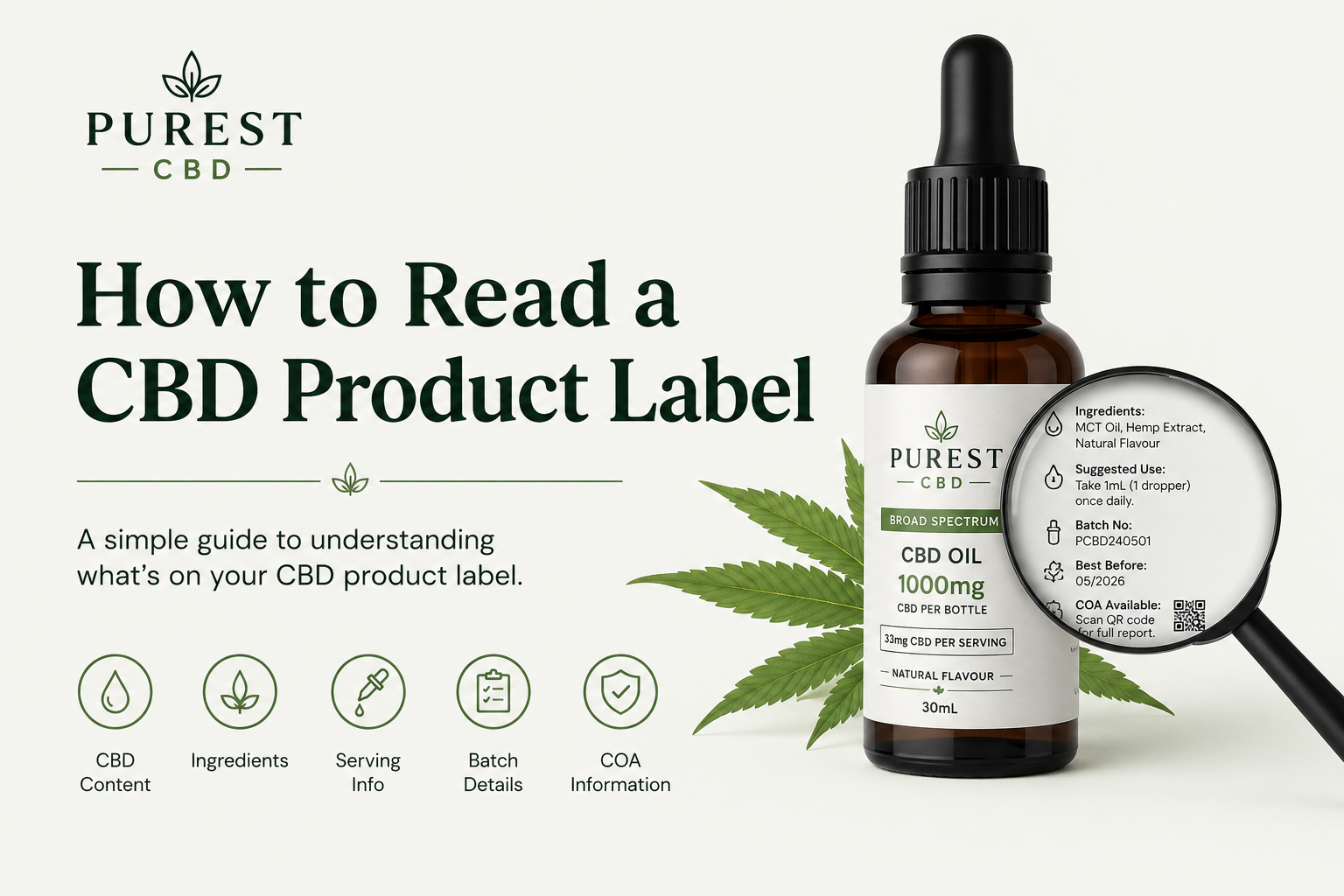
When comparing CBD products, the label can tell you much more than the product name alone. Details such as the total CBD content, container size, ingredients, serving information, batch number and storage directions can all help you understand exactly what you are looking at.
Learning how to read these details also makes it easier to compare different CBD products on a like-for-like basis rather than simply choosing the package with the largest number printed on the front.
Start With the Product Type
The first thing to identify is the type of CBD product.
Common formats include:
- CBD oils
- CBD gummies
- CBD capsules
- CBD topicals
Each format presents its information slightly differently.
For example, a CBD oil label may show the total amount of CBD in the bottle along with the bottle volume in millilitres. Gummies or capsules may instead show both the total CBD in the container and the amount contained in each individual piece.
Understanding the product format makes the rest of the label much easier to interpret.
Look for Broad-Spectrum CBD Information
CBD products may be described using terms such as broad-spectrum.
Broad-spectrum CBD contains multiple hemp-derived compounds and is formulated without detectable THC. Product composition can vary between manufacturers and individual products, so it is important to check the product description and any available laboratory information rather than relying only on the wording on the front of the package.
At Purest CBD Australia, our CBD range consists of broad-spectrum CBD products.
Understand the Total CBD Amount
One of the most important numbers on a CBD label is the total quantity of CBD in the product.
This is commonly displayed in milligrams, written as mg.
For example, a bottle may state that it contains 1,500 mg of CBD. This generally refers to the amount of CBD contained in the entire bottle rather than the amount in each individual serving.
This figure should be considered together with the size of the container.
A larger total CBD number does not automatically mean that one product is directly comparable with another. The volume of an oil bottle or the number of gummies or capsules in the container also matters.
Check the Container Size
For CBD oil, the bottle size will usually be shown in millilitres.
When comparing two oils, consider both:
- the total CBD content in milligrams
- the total bottle volume in millilitres
Looking at both figures gives you a clearer picture than comparing the CBD number alone.
For gummies and capsules, check how many individual pieces are contained in the package.
The packaging may also state how much CBD is contained in each gummy or capsule.
Total CBD vs CBD Per Serving
This is one of the easiest areas to misunderstand.
A label may show:
- total CBD in the entire package
- CBD per millilitre
- CBD per capsule
- CBD per gummy
- CBD per stated serving
These measurements are not interchangeable.
For example, a package containing multiple individual pieces may display a large total CBD figure on the front while the nutrition or product information panel explains how that total is divided between individual pieces.
Always check whether the number you are reading refers to the complete container or a single unit.
Read the Ingredient List
The ingredient list explains what else is contained in the product.
For CBD oils, this may include a carrier oil together with the broad-spectrum hemp extract.
Depending on the product format, additional ingredients may include:
- flavourings
- sweeteners
- capsule materials
- oils
- stabilising ingredients
- other food-grade ingredients
Reading the complete ingredient list can help you compare formulations and identify ingredients you may prefer to avoid.
Do not assume that two products with the same amount of CBD contain the same ingredients.
Check Serving Information Carefully
Some CBD products include a stated serving size and the number of servings contained in the package.
This information helps explain how the manufacturer has presented the product information.
For example, a label may state the amount of CBD contained in one capsule, one gummy or a particular volume of oil.
Serving information should not be confused with personalised dosage advice. Always follow the directions supplied with the specific product.
Find the Batch Number
A batch or lot number connects an individual product to a particular production batch.
This is useful because reputable manufacturers can use the batch number to identify manufacturing and testing information associated with that product.
When Certificate of Analysis information is available, the batch details can also help you determine whether the laboratory documentation corresponds with the product you have purchased.
Check the Expiry or Best-Before Information
CBD products do not remain unchanged indefinitely.
Look for an expiry date, best-before date or similar information on the packaging.
The location varies depending on the product and packaging. It may be printed on the:
- bottle
- base of the container
- outer box
- label
- lid or seal
Check this information when your product arrives and follow the storage directions provided by the manufacturer.
Follow the Storage Directions
Product labels may include instructions explaining how the product should be stored.
CBD products are generally best kept according to the directions printed on their packaging and protected from excessive heat, moisture and direct sunlight.
Keep containers properly closed when they are not being used.
Correct storage helps preserve the product in the condition intended by the manufacturer throughout its stated shelf life.
Look for Certificate of Analysis Information
A Certificate of Analysis, often abbreviated to COA, is a laboratory document containing information about a tested product or production batch.
Depending on the testing performed, a COA may provide information about:
- cannabinoid profile
- CBD concentration
- THC testing
- heavy metals
- pesticides
- residual solvents
- other contaminants
When reviewing a COA, check whether the product or batch information on the document corresponds with the product being sold.
Laboratory information can provide useful additional detail that may not fit on the physical product label.
Compare Products Using Equivalent Measurements
When comparing CBD products, avoid relying on the largest number printed on the package.
Instead, compare equivalent information.
For oils, consider the total CBD amount together with the bottle volume.
For gummies and capsules, consider the total CBD amount, the number of individual pieces and the amount of CBD stated per piece.
Also compare:
- product type
- ingredient list
- broad-spectrum information
- container size
- serving information
- laboratory information
- storage requirements
- expiry information
This gives you a much more complete picture of the product.
CBD Product Label Checklist
Before choosing a CBD product, check whether you can clearly identify:
- The type of CBD product
- Whether it is broad-spectrum
- The total amount of CBD
- The container size
- CBD per individual piece or stated serving where applicable
- The complete ingredient list
- Batch or lot information
- Expiry or best-before information
- Storage instructions
- Available Certificate of Analysis information
A clear product label should make it easier to understand what you are purchasing and to compare similar products using the same information.
Taking a few minutes to review these details can help you make a more informed comparison between CBD products without relying solely on marketing claims or the largest number displayed on the packaging.
Recent Comments