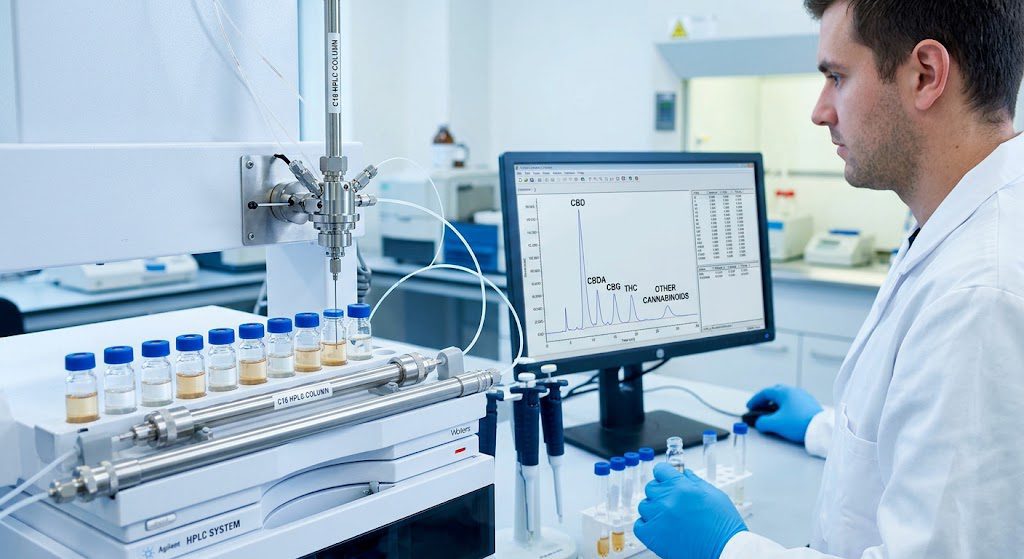
In the evolving landscape of hemp-derived products, verifying cannabinoid concentration and botanical purity is a fundamental requirement. Among various laboratory methodologies, HPLC CBD Testing stands out as the primary analytical standard for evaluating cannabinoid profiles with exceptional precision. By utilising High-Performance Liquid Chromatography, laboratories can separate, identify, and quantify individual cannabinoids in complex liquid extracts. For consumers and industry practitioners seeking transparent information across the Purest CBD Australia educational portal, understanding how liquid chromatography operates provides vital context into modern quality assurance procedures.
Why HPLC CBD Testing Is the Gold Standard in Potency Analysis
Quantifying the exact chemical profile of hemp extracts requires analytical techniques that maintain the chemical integrity of fragile plant compounds. HPLC CBD Testing is universally recognised as the gold standard for cannabinoid analysis primarily because it operates at room temperature, eliminating thermal degradation during testing.
Traditional analytical methods, such as Gas Chromatography (GC), rely on high heat to volatilise samples prior to detection. Heat causes acidic cannabinoids like cannabidiolic acid (CBDA) and tetrahydrocannabinolic acid (THCA) to decarboxylate into CBD and THC during testing, altering the natural ratio of the raw extract. High-Performance Liquid Chromatography circumvents this limitation entirely by passing liquid samples through a stationary phase column under high pressure without heat. Consequently, HPLC delivers an exact, unaltered representation of both neutral and acidic cannabinoid species in raw plant material and finished broad-spectrum formulations.
Furthermore, HPLC offers superior sensitivity when resolving structurally similar cannabinoids. Minor constituents such as cannabigerol (CBG), cannabinol (CBN), and cannabichromene (CBC) often exist in minute concentrations alongside predominant cannabinoids. The high-resolution capability of liquid chromatography ensures that these minor compounds are accurately differentiated and quantified without interferences.
7 Essential Analytical Steps in Rigorous HPLC CBD Testing
To produce reliable batch analytics, analytical chemists follow a meticulous, multi-stage protocol during liquid chromatography. The primary seven steps involved in complete testing include:
- Sample Homogenisation: Raw hemp biomass, crude extracts, or finished oils are thoroughly blended to ensure a representative sample is collected for testing.
- Solvent Extraction: A precise quantity of the homogenised sample is dissolved in an appropriate mobile-phase solvent, such as high-purity methanol or acetonitrile, to solubilise target cannabinoids.
- Sample Filtration: The liquid mixture is passed through sub-micron PTFE or nylon membrane filters to remove particulate matter that could obstruct chromatography columns.
- High-Pressure Injection: The filtered liquid extract is injected into the mobile phase stream, which pumps the sample under high hydraulic pressure into the stationary phase column.
- Chromatographic Separation: Compounds interact differently with the stationary column packing based on molecular polarity, causing individual cannabinoids to elute at distinct retention times.
- Spectrophotometric Detection: As separated compounds exit the column, a UV-Vis or photodiode array (PDA) detector measures light absorption at specific wavelengths (typically 220 nm or 228 nm).
- Quantification and CoA Reporting: Spectral peak areas are calculated against established reference standards to produce a comprehensive Certificate of Analysis detailing weight percentages and milligram concentrations.
Ensuring Regulatory Compliance and Australian Standards
In Australia, quality verification is tied closely to strict safety and composition standards established for industrial hemp products and broad-spectrum extracts. Regulatory guidelines overseen by authoritative bodies such as the Therapeutic Goods Administration (TGA) emphasize the necessity of verified batch testing, accurate labeling, and non-detectable levels of restricted psychoactive compounds.
Rigorous liquid chromatography allows testing facilities to confirm that broad-spectrum extracts adhere to non-detectable THC thresholds (often below 0.005% w/w) while preserving non-psychoactive secondary cannabinoids and terpenes. Moreover, routine quality control testing ensures batch-to-batch consistency across manufacturing cycles, protecting product stability, label integrity, and consumer confidence.
Alongside cannabinoid potency profiling, comprehensive testing frameworks frequently combine liquid chromatography with mass spectrometry (LC-MS/MS) and gas chromatography to screen for potential contaminants. These complementary analyses verify the complete absence of residual extraction solvents, heavy metals, pesticides, microbial pathogens, and mycotoxins in finished botanical preparations.
Frequently Asked Questions About HPLC CBD Testing
How does HPLC differ from Gas Chromatography (GC) for CBD testing?
HPLC analyses samples in a liquid mobile phase at ambient temperatures, allowing acidic compounds (CBDA, THCA) and neutral compounds (CBD, THC) to be measured independently. Gas Chromatography uses high temperatures, which automatically decarboxylates acidic cannabinoids into their neutral forms during analysis.
Why is HPLC essential for broad-spectrum CBD extracts?
Broad-spectrum extracts require precise identification of multiple minor cannabinoids while confirming the complete removal of THC. High-Performance Liquid Chromatography offers the necessary sensitivity and baseline resolution to separate subtle cannabinoid peaks accurately.
How often should hemp batches undergo HPLC analysis?
Every commercial batch of raw hemp extract and finished product should undergo independent HPLC analysis. Regular testing ensures consistent potency, verifies formulation accuracy, and confirms compliance with strict Australian quality guidelines.
Prioritising Quality Through Advanced Analytical Testing
Understanding analytical methods provides valuable insight into how premium hemp products maintain high purity and consistent formulation profiles. Through standardized HPLC CBD Testing, laboratory analysts can verify cannabinoid concentrations with unwavering accuracy, supporting transparency across the industry. As testing technology continues to advance, liquid chromatography remains the cornerstone of quality verification, empowering consumers with reliable botanical information grounded in solid science.
Recent Comments