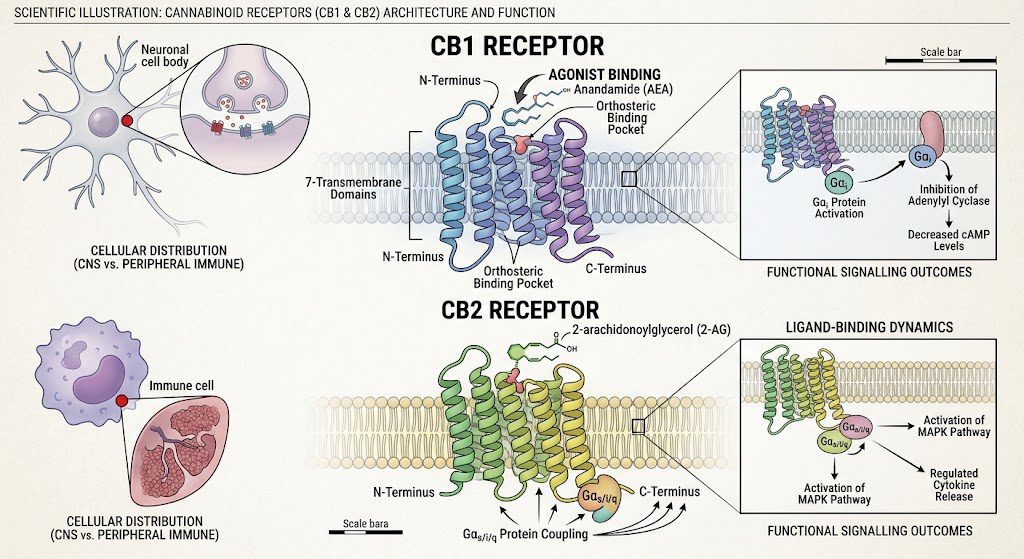
Understanding how botanical compounds interact with human physiology requires a clear look at cell signalling pathways, particularly how Cannabinoid Receptors Explained in modern biochemistry function across body systems. The endocannabinoid system relies on complex cellular receptors to maintain homeostatic balance. Within the body, these specialised protein structures receive signals from both endogenously produced molecules and exogenous phytocannabinoids derived from industrial hemp plant extracts.
In Australian research and educational science, studying these receptor pathways provides essential insight into botanical composition and receptor affinity. Below, we outline 5 proven key functions of cannabinoid receptors, examining their distribution, structural characteristics, and physiological mechanisms in standard biological contexts.
1. Cannabinoid Receptors Explained: Primary CB1 and CB2 Receptor Architecture
Cannabinoid receptors belong to the G-protein coupled receptor (GPCR) superfamily, which represents one of the largest classes of cell-surface signal transducers in human biology. The two primary receptors identified and studied extensively are CB1 and CB2. While both share structural similarities in their seven-transmembrane domain configuration, they exhibit distinct distribution patterns and signalling mechanics throughout tissue networks.
CB1 receptors are predominantly localised within the central nervous system, including high concentrations in the cerebral cortex, basal ganglia, hippocampus, and cerebellum. Conversely, CB2 receptors are primarily situated within peripheral immune tissues, such as the spleen, tonsils, and circulating immune cells. Understanding this anatomical distribution helps clarify why different botanical extracts elicit varied physiological interactions depending on their affinity profiles and molecular structures.
2. Ligand Binding Dynamics and Allosteric Modulation
The interaction between cannabinoids and cellular receptors depends on molecular binding affinity. Endogenous ligands like anandamide (AEA) and 2-arachidonoylglycerol (2-AG) act as natural agonists, binding directly to orthosteric active sites on CB1 and CB2 receptors. In contrast, non-intoxicating phytocannabinoids like cannabidiol (CBD) often exhibit low direct binding affinity for primary orthosteric sites, functioning instead through non-competitive negative allosteric modulation.
Allosteric modulation alters the shape of the receptor protein, subtly changing how other ligands bind to it without directly activating the receptor itself. This distinct mechanism of action is a core topic in phytocannabinoid chemistry, demonstrating how non-intoxicating hemp constituents can modulate signal transduction pathways without directly stimulating central CB1 activity.
3. Cannabinoid Receptors Explained: Signal Transduction Pathways
When a ligand binds to a cannabinoid receptor, it initiates a cascade of intracellular events known as signal transduction. Once activated, the coupled G-protein dissociates into G-alpha and G-beta-gamma subunits, which subsequently regulate downstream effector enzymes such as adenylyl cyclase and mitogen-activated protein kinase (MAPK) pathways.
In general, CB1 and CB2 receptors are coupled to Gi/o proteins, which inhibit adenylyl cyclase activity and decrease cyclic adenosine monophosphate (cAMP) accumulation within the cell. Additionally, CB1 receptor activation can regulate voltage-gated calcium channels and inwardly rectifying potassium channels. This delicate regulation of cellular ion flux underscores the sophisticated regulatory role cannabinoid receptors play in maintaining cellular homeostasis across biological systems.
4. Retrograde Signalling in Neurotransmission
Unlike traditional neurotransmitters stored in presynaptic vesicles and released upon action potentials, endocannabinoids function via retrograde signalling. Postsynaptic neurons synthesise endocannabinoids on demand from membrane phospholipid precursors in response to intracellular calcium influx.
Once synthesised, these lipid messengers travel backward across the synaptic cleft to bind presynaptic CB1 receptors. This binding transiently suppresses presynaptic neurotransmitter release, acting as a feedback loop that moderates synaptic activity. This unique retrograde feedback system is essential for preserving balanced neurochemical communication across neuronal circuits.
5. Quality Testing, Purity, and Regulatory Standards
For educational researchers and consumers evaluating hemp-derived extracts, understanding receptor mechanics highlights the importance of standardised product formulation. High-quality phytocannabinoid extracts undergo rigorous analytical testing—such as High-Performance Liquid Chromatography (HPLC)—to verify cannabinoid profiles, purity levels, and the absence of contaminants.
In Australia, regulatory frameworks established by authoritative bodies like the Therapeutic Goods Administration (TGA) govern safety, quality, and labelling requirements for therapeutic goods and botanical products. Ensuring that hemp extracts comply with stringent Australian manufacturing guidelines guarantees consistent molecular purity and accurate labelling for all consumers exploring educational resources on our Purest CBD Australia blog.
Cannabinoid Receptors Explained: 5 Key Functions
What are CB1 and CB2 receptors?
CB1 and CB2 receptors are membrane-bound G-protein coupled receptors that form the principal signalling nodes of the endocannabinoid system. CB1 receptors are mostly located in the brain and central nervous system, while CB2 receptors are primarily found in immune tissues and peripheral organs.
How does CBD interact with cannabinoid receptors?
Unlike THC, which acts as a direct agonist at CB1 receptors, CBD has low direct affinity for orthosteric CB1 and CB2 sites. Instead, CBD acts as a negative allosteric modulator of CB1 receptors and interacts with secondary cellular targets, influencing signalling pathways indirectly.
Why is retrograde signalling significant in cell communication?
Retrograde signalling allows postsynaptic cells to send feedback to presynaptic cells on demand. This backward transmission helps regulate neurotransmitter release, serving as a critical biological buffer to maintain cellular balance within neural pathways.
In summary, having Cannabinoid Receptors Explained in clear scientific terms provides a solid foundation for understanding how the endocannabinoid system supports cellular balance and signalling across biological systems.
Recent Comments