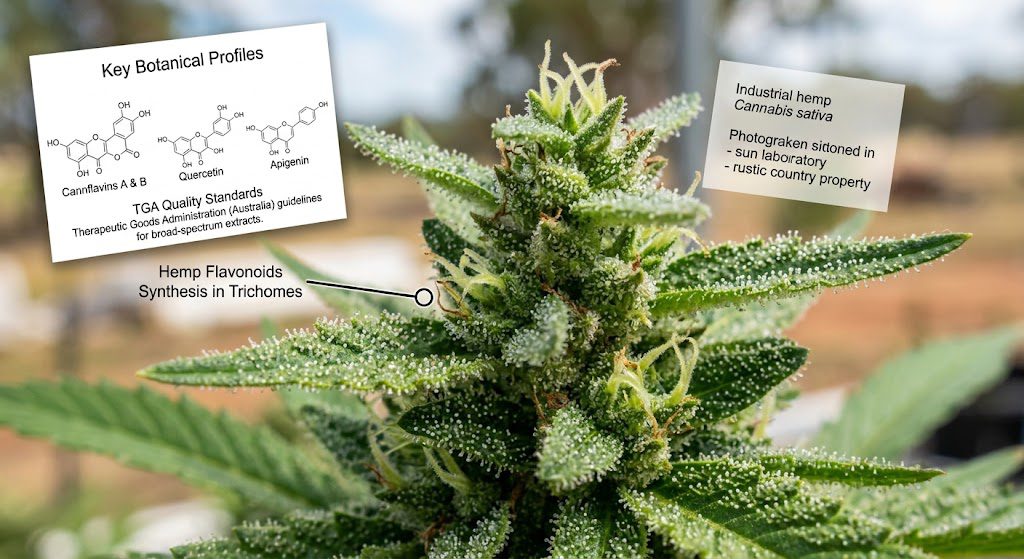
In the field of botanical plant chemistry, Hemp Flavonoids represent a crucial class of secondary metabolites that contribute to the overall complex phytochemical profile of the Cannabis sativa plant. While cannabinoids such as cannabidiol (CBD) and volatile terpenes frequently dominate educational discussions, flavonoids play an equally vital role in shaping the natural characteristics, pigmentation, and overall chemical composition of broad-spectrum hemp extracts. Understanding how Hemp Flavonoids interact with other naturally occurring botanical compounds provides valuable insight into the comprehensive science behind high-quality industrial hemp formulations.
What Are Hemp Flavonoids and How Do They Function?
Flavonoids are polyphenolic compounds widely distributed throughout the plant kingdom, responsible for vivid pigmentation, ultraviolet protection, and ecological defence mechanisms. In industrial hemp cultivars, Hemp Flavonoids are synthesised through specialized metabolic pathways within the plant tissues, particularly in the leaf structures and floral trichomes.
Key natural compounds identified within hemp profiles include:
- Cannflavins (A, B, and C): Unique prenylated flavones specific to the genus Cannabis that are not found in other plant species.
- Quercetin & Kaempferol: Ubiquitous dietary flavonoids known for their fundamental role in plant cellular structure and environmental adaptation.
- Apigenin & Luteolin: Flavone molecules that contribute to structural stability and botanical colouration.
These compounds work in concert with volatile terpenes and non-psychoactive cannabinoids, forming a balanced botanical matrix preserved during gentle extraction processes.
The Role of Hemp Flavonoids in Broad-Spectrum Phytochemical Profiles
When raw hemp biomass undergoes clean, modern extraction techniques—such as supercritical fluid carbon dioxide extraction—the objective is to capture the full spectrum of beneficial plant compounds while removing undesirable wax and chlorophyll. During this process, Hemp Flavonoids are preserved alongside cannabinoids and terpenes, creating a rich broad-spectrum extract.
Unlike isolated compounds, broad-spectrum extracts preserve the synergistic chemistry inherent to the whole plant. The presence of Hemp Flavonoids ensures that the natural integrity of the raw botanical material remains intact. Quality extraction standardisation guarantees that delicate phenolic structures are not degraded by excessive heat or harsh chemical solvents, yielding a clean and reliable finished product suitable for consumer testing and formulation.
Analyzing 7 Key Secondary Metabolite Profiles in Hemp
To better appreciate the botanical diversity of industrial hemp, plant researchers categorize its primary phytochemical groups into distinct chemical profiles. Evaluating these profiles helps consumers and industry professionals understand the complete composition of hemp extracts:
- Prenylated Flavones (Cannflavin A & B): Specialized polyphenols unique to hemp that define its specific chemical fingerprint.
- Standard Flavonols (Quercetin): Common plant compounds providing cellular protection and contributing to natural pigmentation.
- Flavone Glycosides (Luteolin): Water-soluble compound variations that support plant physiological function.
- Monoterpenes (Myrcene & Pinene): Aromatic hydrocarbons responsible for distinct herbal aromas.
- Sesquiterpenes (Beta-Caryophyllene): Complex terpene molecules that interact with botanical lipids.
- Major Cannabinoids (CBD & CBG): Non-intoxicating phytocannabinoids that constitute the core active profile.
- Minor Cannabinoids (CBC & CBDV): Trace cannabinoid compounds that complete the natural extract spectrum.
Laboratory testing using high-performance liquid chromatography ensures that each batch reflects these balanced profiles without synthetic additives or contaminants.
Quality Control, Testing, and TGA Guidelines
Ensuring the safety, purity, and consistency of hemp-derived products requires strict analytical testing protocols. In Australia, the regulatory framework maintained by the Therapeutic Goods Administration (TGA) sets stringent quality standards for therapeutic goods and botanical extracts.
Independent Certificate of Analysis documentation verifies the absence of heavy metals, pesticides, residual solvents, and unwanted synthetic contaminants. Furthermore, analytical testing confirms that total tetrahydrocannabinol (THC) levels comply with legal requirements, maintaining full non-intoxicating integrity while verifying the natural concentration of Hemp Flavonoids and other beneficial secondary plant metabolites.
Frequently Asked Questions About Hemp Flavonoids
What makes Hemp Flavonoids distinct from terpenes?
Flavonoids are polyphenolic plant pigments that provide colour, structural defence, and specific chemical properties, whereas terpenes are volatile aromatic hydrocarbons responsible for smell and aroma profiles. Both coexist naturally in industrial hemp.
Are Hemp Flavonoids removed during broad-spectrum CBD extraction?
When clean extraction methods like supercritical carbon dioxide extraction are employed under controlled temperatures, delicate Hemp Flavonoids are retained along with broad-spectrum cannabinoids and terpenes.
How do lab reports confirm the presence of flavonoids?
Advanced laboratory analysis, including high-performance liquid chromatography and mass spectrometry, profiles individual phenolic compounds to verify natural composition and consistency across product batches. You can learn more about broad-spectrum extract testing on our Purest CBD Blog.
Conclusion
In summary, Hemp Flavonoids represent a vital yet often overlooked pillar of hemp botanical science. By understanding how these unique polyphenolic compounds contribute to broad-spectrum plant profiles, consumers can make informed choices based on rigorous quality control, clean extraction, and transparent third-party laboratory verification. For further educational guides on botanical plant chemistry and clean extraction practices, explore our resource library.
Recent Comments