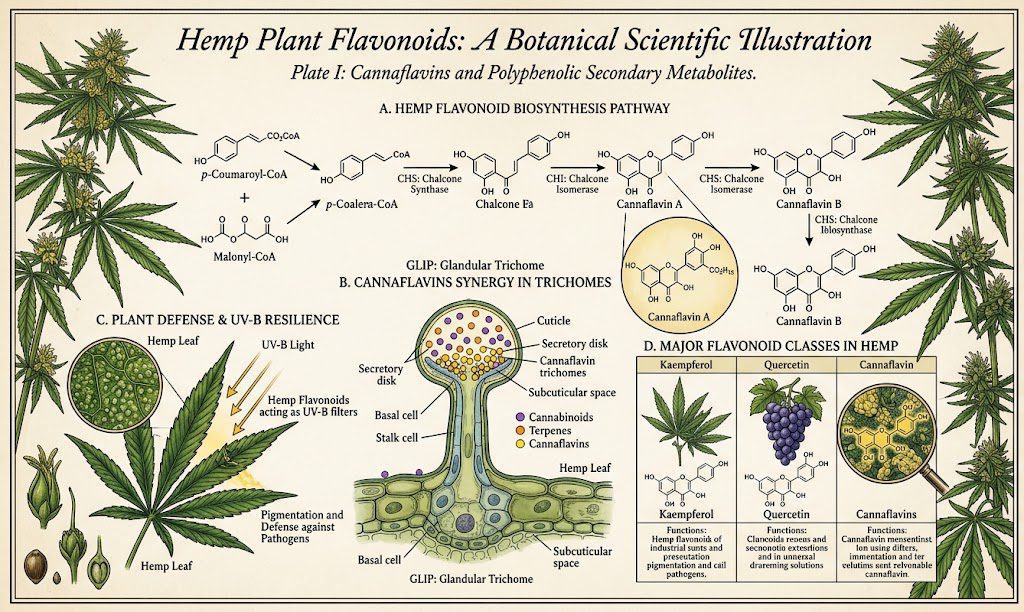
When exploring the phytochemical complexity of industrial hemp (Cannabis sativa L.), Hemp Flavonoids represent one of the most intriguing yet underappreciated groups of plant compounds. While much of the popular discussion centres on cannabinoids like cannabidiol (CBD) and aromatic terpenes, secondary plant metabolites known as flavonoids play a critical role in the botanical architecture of hemp. These naturally occurring polyphenolic constituents contribute significantly to the plant’s structural resilience, pigmentation, and broader phytochemical profile. For Australian consumers and researchers seeking clear, educational insights into hemp science, understanding how Hemp Flavonoids function alongside other botanical elements provides essential context when reviewing broad-spectrum formulations and plant-derived products. You can explore more educational resources across our Purest CBD Australia Blog.
Understanding Hemp Flavonoids in Cannabinoid Research
Flavonoids are ubiquitous throughout the plant kingdom, responsible for the vibrant colours found in berries, green tea, citrus fruits, and flora. In industrial hemp, Hemp Flavonoids account for approximately 2 to 3 percent of the plant’s total dry weight. Chemically, they are categorised as polyphenolic secondary metabolites comprising a fifteen-carbon skeleton arranged in two benzene rings joined by a three-carbon heterocyclic chain.
What makes industrial hemp particularly unique within plant taxonomy is the presence of specialised flavonoids known as cannaflavins—specifically Cannaflavin A, Cannaflavin B, and Cannaflavin C. These prenylated flavonoids are synthesised exclusively within Cannabis sativa and are structurally distinct from flavonoids commonly found in standard dietary sources. Within broad-spectrum botanical research, scientists examine how these specialised compounds exist in harmony with minor cannabinoids and terpenes, contributing to the complete, unrefined profile of the hemp plant prior to processing.
Key Botanical Roles of Hemp Flavonoids in Plant Science
From a physiological perspective, flavonoids serve several vital biological functions in the living hemp plant. Primarily synthesised in the leaves, flowers, and glandular trichomes, Hemp Flavonoids act as natural shields against environmental stressors.
First, they function as natural ultraviolet (UV) filters, protecting sensitive plant tissue from high solar radiation during peak growth cycles. Second, they provide pigmentation that gives hemp foliage its characteristic deep green and subtle yellow hues. Third, these compounds act as botanical defence mechanisms, deterring herbivores and fungal pathogens through their natural bitter taste and structural reactivity. According to guidance on botanical classifications from the Therapeutic Goods Administration, understanding plant chemistry and raw material specifications is fundamental to maintaining quality, stability, and regulatory consistency across Australian botanical standards.
How Extraction Methods Preserve Hemp Flavonoids
The retention of secondary metabolites during processing depends heavily on the extraction methodology employed. Because flavonoids possess specific solubility and thermal sensitivity thresholds, maintaining precise laboratory controls is essential during extraction.
Supercritical carbon dioxide (CO2) extraction and cold-ethanol solvent processing represent two of the most widely recognised methods for isolating hemp extracts while preserving fragile plant compounds. Under controlled low-temperature and high-pressure conditions, supercritical CO2 efficiently pulls cannabinoids, terpenes, and Hemp Flavonoids from raw biomass without exposing them to destructive thermal degradation. In broad-spectrum manufacturing processes, winterisation and filtration further refine the raw extract, removing unwanted lipids and waxes while preserving the beneficial polyphenolic spectrum. This careful handling ensures that the resulting raw material retains its natural compound integrity.
Laboratory Testing and Identifying Hemp Flavonoids
To verify the composition and purity of hemp extracts, reputable producers rely on rigorous third-party analytical testing. High-Performance Liquid Chromatography (HPLC) is the standard laboratory technique used to quantify phytocannabinoid and flavonoid profiles.
Through HPLC analysis, specialised laboratories measure individual compound concentrations against calibrated reference standards, recording the exact botanical signature on a Certificate of Analysis (CoA). Testing for Hemp Flavonoids alongside cannabinoid content ensures that broad-spectrum ingredients remain compliant, uniform, and free from thermal breakdown or residual chemical solvents. Readers interested in learning more about quality assurance and lab standards can review our guides under CBD Education.
7 Essential Botanical Attributes of Hemp Flavonoids
To better understand the distinct characteristics of these natural plant compounds, consider these seven primary botanical attributes:
- Unique Cannaflavin Synthesis: Hemp synthesises specific prenylated flavonoids—Cannaflavins A, B, and C—that are found nowhere else in the botanical kingdom.
- Photoprotective Functions: These compounds absorb harmful ultraviolet wavelengths, guarding fragile cellular structures in hemp leaves and flowers.
- Synergistic Co-existence: Flavonoids exist in natural proportion alongside cannabinoids and terpenes within raw hemp trichomes.
- Polyphenolic Structure: Belonging to the polyphenolic chemical class, flavonoids possess distinct antioxidant potential within living plant tissue.
- Thermal Sensitivity: High processing temperatures can degrade flavonoid structures, making low-temperature CO2 extraction preferred for preservation.
- Analytical Identifiability: Standardised HPLC testing methods can isolate and measure flavonoid concentrations alongside major and minor cannabinoids.
- Natural Pigmentation: Flavonoid compounds contribute to the natural colouration of raw hemp biomass and concentrated plant extracts.
Frequently Asked Questions About Hemp Flavonoids
What are hemp flavonoids and why are they present in hemp?
Hemp flavonoids are naturally occurring polyphenolic secondary metabolites produced by industrial hemp plants (Cannabis sativa L.). They serve key biological roles in the plant, including protection against solar ultraviolet light, pigmentation, and defence against environmental factors.
How do hemp flavonoids differ from terpenes and cannabinoids?
While cannabinoids interact with physiological pathways and terpenes provide aromatic properties, flavonoids are structural polyphenols primarily involved in plant pigmentation, UV absorption, and cellular protection. Each group represents a distinct chemical class within the hemp plant’s phytochemical matrix.
Are hemp flavonoids retained during broad-spectrum extraction?
Yes, when gentle, low-temperature extraction methods such as supercritical CO2 or cold ethanol extraction are used, fragile hemp flavonoids can be retained along with cannabinoids and terpenes while removing unwanted plant waxes and non-detectable levels of THC.
Conclusion
In summary, Hemp Flavonoids represent an essential dimension of industrial hemp chemistry, offering key insights into plant physiology, extraction preservation, and botanical purity. As analytical testing methods continue to advance, verifying the complete polyphenolic profile of broad-spectrum raw materials remains an integral benchmark for Australian quality standards. By understanding how these unique plant compounds function alongside cannabinoids and terpenes, consumers and industry professionals alike can better appreciate the complete botanical science behind hemp-derived products.
Recent Comments