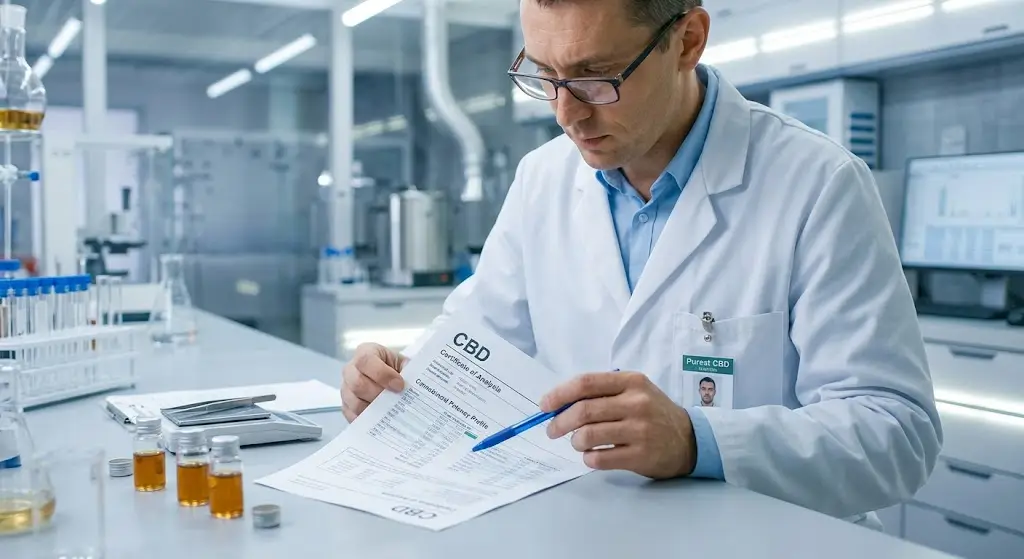
Navigating the broad-spectrum hemp market requires a practical understanding of product quality, purity, and verification methods. For any consumer or retailer evaluating standardisation standards, reviewing a CBD Certificate of Analysis (COA) is the single most reliable way to verify what is inside a given product batch. A CBD Certificate of Analysis is an official analytical document issued by an independent, third-party laboratory that details the precise chemical breakdown, cannabinoid concentration, and purity metrics of a hemp-derived extract.
In Australia, clear documentation and third-party laboratory oversight are central to maintaining consumer transparency. Regulatory framework oversight, such as guidelines provided by the Therapeutic Goods Administration (TGA), emphasises rigorous standards for product composition and testing protocols. Understanding how to read these reports ensures you can independently verify batch consistency, botanical origin, and overall purity across published educational resources on the Purest CBD Australia blog.
What Is a CBD Certificate of Analysis?
A Certificate of Analysis serves as an uncompromised snapshot of a product’s laboratory profile. When raw hemp extract is processed, batches are submitted to certified analytical facilities. Specialised testing equipment, such as High-Performance Liquid Chromatography (HPLC) and Gas Chromatography-Mass Spectrometry (GC-MS), is utilised to isolate and measure individual compounds.
The resulting document outlines two main primary evaluation categories: cannabinoid potency profiling and contaminants screening. Accessing a third-party laboratory report guarantees that the findings are unbiased and unedited by manufacturers. Examining these documents allows individuals to confirm that broad-spectrum formulations remain non-psychoactive while maintaining complete trace transparency.
5 Key Components of a CBD Certificate of Analysis
Reading through a multi-page analytical report can initially appear technical. However, systematically reviewing five core sections makes interpreting any laboratory report straightforward:
- 1. Header Information & Batch Matching: Always check that the batch number, product name, and manufacturer printed on the product packaging match the details listed on the COA header. Additionally, confirm the date of analysis to ensure the laboratory results are current for the specific production lot.
- 2. Cannabinoid Potency Profile: This section displays the concentration of primary phytocannabinoids present in the sample, typically listed as milligrams per gram (mg/g) or total percentage (%). Review the levels of Cannabidiol (CBD) alongside minor non-intoxicating compounds such as Cannabigerol (CBG) and Cannabinol (CBN).
- 3. Tetrahydrocannabinol (THC) Limits: Broad-spectrum extracts are carefully processed to remove detectable levels of Delta-9-THC. Verify that the laboratory report confirms non-detectable (ND) or compliant trace thresholds for THC.
- 4. Heavy Metal & Pesticide Screen: Because the hemp plant is a natural bioaccumulator, it draws minerals and elements directly from soil. Comprehensive laboratory testing verifies the absence or safety compliance of heavy metals (lead, arsenic, cadmium, mercury) and synthetic agricultural pesticides.
- 5. Residual Solvents & Microbiological Analysis: Extraction methods utilise various refined carrier processes. Solvents testing verifies that zero harmful residual solvents remain after extraction, while microbiological screening confirms freedom from mould, yeast, salmonella, and E. coli.
How to Verify Testing Authenticity and Standards
Evaluating a laboratory report requires ensuring that the document originates from a legitimate testing facility. Always verify that the testing facility possesses ISO/IEC 17025 accreditation, which indicates international standardisation for testing and calibration laboratories. Legitimate reports prominently display accreditation badges along with digital signatures from qualified laboratory directors.
Furthermore, scanning QR codes embedded on product packaging should lead directly to hosted laboratory certificates rather than static marketing images. Cross-referencing batch numbers provides confidence in product integrity and quality control. Exploring detailed educational content on our CBD quality testing resources can further assist in identifying authentic broad-spectrum documentation standards.
Frequently Asked Questions About CBD Certificate of Analysis
What does ‘ND’ mean on a laboratory report?
‘ND’ stands for ‘Not Detected’. It indicates that the specific compound, such as THC or a solvent residue, fell below the laboratory’s limit of detection (LOD) threshold, confirming its effective absence from the tested sample.
Why is third-party testing necessary if a brand tests internally?
Internal testing offers preliminary quality control for manufacturers, but third-party testing provides an independent, objective analysis. Third-party laboratories have no commercial incentive to alter results, ensuring unbiased verification of potency and purity.
How often should a CBD Certificate of Analysis be updated?
A fresh COA should be generated for every distinct manufacturing batch or lot produced. Because natural botanical harvests vary across seasons, batch-specific testing ensures that concentration levels and purity metrics remain consistent across every production run.
Can I view a COA before purchasing a hemp product?
Yes, reputable distributors provide public access to batch-specific lab reports directly on their websites or via scannable QR codes printed on product packaging prior to purchase.
Evaluating Your CBD Certificate of Analysis
Developing the ability to interpret a CBD Certificate of Analysis empowers consumers and retailers to make informed, data-driven decisions regarding broad-spectrum hemp extracts. By systematically reviewing header details, potency metrics, THC compliance thresholds, and contamination screens, you can independently confirm product quality and safety standards. Always prioritise products backed by verifiable, accredited third-party lab documentation to ensure complete transparency across every batch.
Recent Comments