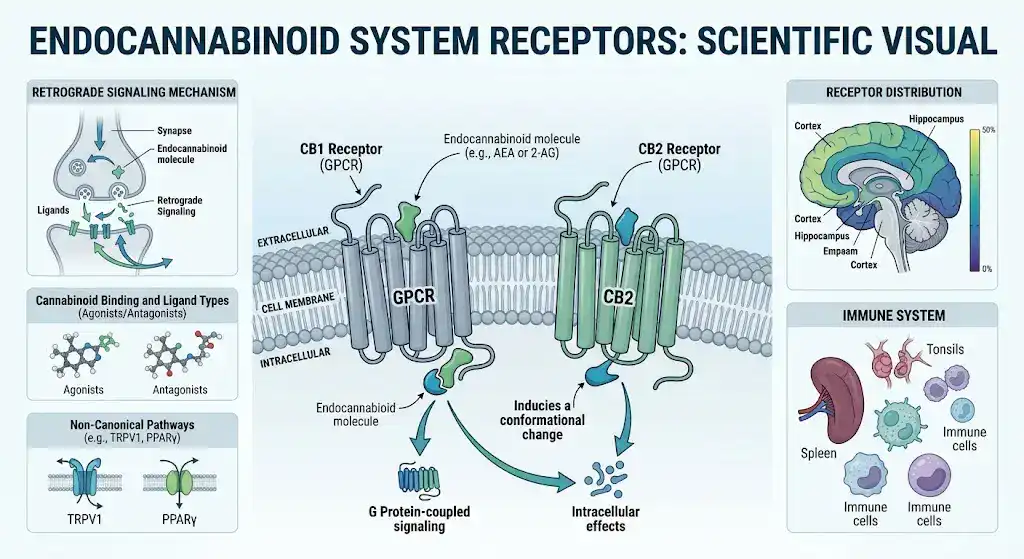
Endocannabinoid system receptors serve as crucial regulatory structures within mammalian physiology, acting as specialized cell-surface sites that respond to both endogenous signaling molecules and phytocannabinoids. Modern biological research continues to explore how these specialized protein structures interact within human physiological systems to maintain internal balance, known scientifically as homeostasis. Understanding the functional pathways of endocannabinoid system receptors offers valuable insight into how plant-derived compounds engage with complex biological networks without making therapeutic claims regarding disease treatment.
The discovery of cell surface receptor sites specifically designed to interact with lipid-based signaling compounds revolutionized our understanding of neurobiology and cellular communication. As educational frameworks across Australia expand regarding botanical constituents, researchers at Purest CBD Australia regularly emphasize the importance of understanding underlying anatomical mechanics. By examining receptor distribution, chemical binding affinities, and cellular signaling cascades, observers can better appreciate the complex interplay between plant science and human biochemistry.
Understanding Endocannabinoid System Receptors in Human Physiology
Within the human body, receptor proteins act as cellular receivers, waiting for specific ligand molecules to lock into their binding pockets. Endocannabinoid system receptors belong primarily to the G protein-coupled receptor (GPCR) superfamily, which represents one of the largest and most versatile classes of signal transducers in cellular biology. When an extracellular molecule binds to the active site of these receptors, it triggers a conformational change inside the cell, setting off an intracellular signaling cascade that modulates various biological functions.
The two primary subtypes that have been isolated and extensively categorized by international researchers are Cannabinoid Receptor Type 1 (CB1) and Cannabinoid Receptor Type 2 (CB2). While both share common structural features, their distribution across human tissues and their functional roles vary significantly:
- CB1 Receptors: Predominantly concentrated within the central nervous system, particularly in regions such as the cerebral cortex, basal ganglia, hippocampus, and cerebellum. They play a vital role in modulating neurotransmitter release across synaptic junctions.
- CB2 Receptors: Primarily localized in peripheral tissues, specifically within immune system components such as microglial cells, spleen tissue, tonsils, and white blood cells. They are principally involved in immune response regulation and cellular defense mechanisms.
Compliance guidelines established by regulatory authorities like the Therapeutic Goods Administration (TGA) require all educational materials to distinguish clearly between general physiological mechanisms and medical therapeutic outcomes. While receptor activation is an integral aspect of normal biological activity, phytocannabinoid interaction with these pathways does not constitute a cure or medical intervention for health conditions.
5 Key Proven Facts About Endocannabinoid System Receptors
To assist consumers and researchers in navigating botanical science, we have compiled five essential, scientifically verified observations regarding the structure and behavior of endocannabinoid system receptors:
1. Retrograde Neurotransmission Dynamics
Unlike conventional neurotransmitters such as glutamate or GABA, which travel forward from presynaptic neurons to postsynaptic neurons, endocannabinoid molecules operate through retrograde signaling. Synthesized on demand from membrane phospholipids in response to intracellular calcium influx, endocannabinoids travel backward across the synaptic cleft to activate presynaptic CB1 receptors. This unique mechanism acts as a natural feedback loop, suppressing excessive presynaptic neurotransmitter release to maintain cellular equilibrium.
2. Tissue-Specific Distribution Patterns
The anatomical placement of CB1 and CB2 receptors dictates their physiological impact. CB1 receptors represent one of the most abundant GPCR types in the mammalian brain, influencing motor coordination, sensory perception, and memory processing. Conversely, CB2 receptors are sparsely expressed in healthy brain tissue under basal conditions but show high expression in immune cells, modulating signaling pathways related to cellular homeostasis throughout peripheral organs.
3. Distinct Ligand Affinity and Agonism
Receptor dynamics are defined by how molecules bind to and activate receptor sites. Endogenous ligands like Anandamide (AEA) act as partial agonists at CB1 and CB2 receptors, whereas 2-Arachidonoylglycerol (2-AG) functions as a full agonist at both sites. Phytocannabinoids exhibit distinct binding affinities; for instance, broad-spectrum compounds may display low direct affinity for CB1/CB2 active sites while influencing non-canonical receptor pathways or enzymatic degradation mechanisms.
4. Non-Canonical Receptor Cross-Talk
Emerging research demonstrates that endocannabinoid system receptors do not work in complete isolation. CB1 and CB2 receptors frequently form heteromers—complexes composed of two or more distinct receptor types—with dopamine, adenosine, and opioid receptors. Furthermore, non-canonical candidate receptors such as Transient Receptor Potential Vanilloid 1 (TRPV1) and Peroxisome Proliferator-Activated Receptor gamma (PPARγ) interact closely with endocannabinoid pathways, broadening the scope of lipid signaling.
5. Enzymatic Regulation and Receptor Turnover
The duration and intensity of receptor activation are tightly controlled by enzymatic degradation. Key enzymes such as Fatty Acid Amide Hydrolase (FAAH) and Monoacylglycerol Lipase (MAGL) rapidly break down endocannabinoids once signaling tasks are completed. This efficient inactivation prevents continuous overstimulation of cell surface receptors, highlighting the self-regulating nature of human biological signaling networks.
Evaluating Phytocannabinoid Interactions Beyond Classic Receptors
When studying botanical extracts, it is vital to understand that non-intoxicating cannabinoids do not directly stimulate CB1 receptors in the same manner as THC. Instead, broad-spectrum hemp extracts interact through indirect pathways. They may influence enzyme activity, modulate receptor sensitivity, or bind to allosteric sites—locations on the receptor separate from the primary ligand-binding pocket. Allosteric modulation can subtly alter the receptor’s shape, modifying how effectively primary signaling molecules attach to the target site.
Educational analysis provided by Purest CBD Australia aims to clarify these complex biochemical concepts, fostering transparent knowledge regarding clean extraction and natural plant compounds.
Frequently Asked Questions About Endocannabinoid System Receptors
What are endocannabinoid system receptors?
Endocannabinoid system receptors are specialized proteins embedded in cell membranes throughout the human body. They receive signals from endogenous lipid molecules (endocannabinoids) and plant-derived phytocannabinoids, helping to regulate various physiological processes necessary for biological balance.
Where are CB1 and CB2 receptors located in the body?
CB1 receptors are predominantly located in the central nervous system, including the brain and spinal cord. CB2 receptors are mostly concentrated in peripheral tissues, immune system organs, and circulatory cells throughout the body.
How do broad-spectrum CBD compounds interact with endocannabinoid system receptors?
Broad-spectrum CBD compounds do not bind strongly to the primary active sites of CB1 or CB2 receptors. Instead, they operate through indirect mechanisms, such as modulating allosteric sites, influencing membrane channels, or inhibiting enzymes like FAAH that break down natural endocannabinoids.
In conclusion, ongoing scientific research into endocannabinoid system receptors highlights the remarkable complexity of biological signaling. By maintaining strict educational standards and observing TGA guidelines, we can appreciate the natural mechanisms through which plant science and cellular biology intersect without making unproven medical assertions.
Recent Comments