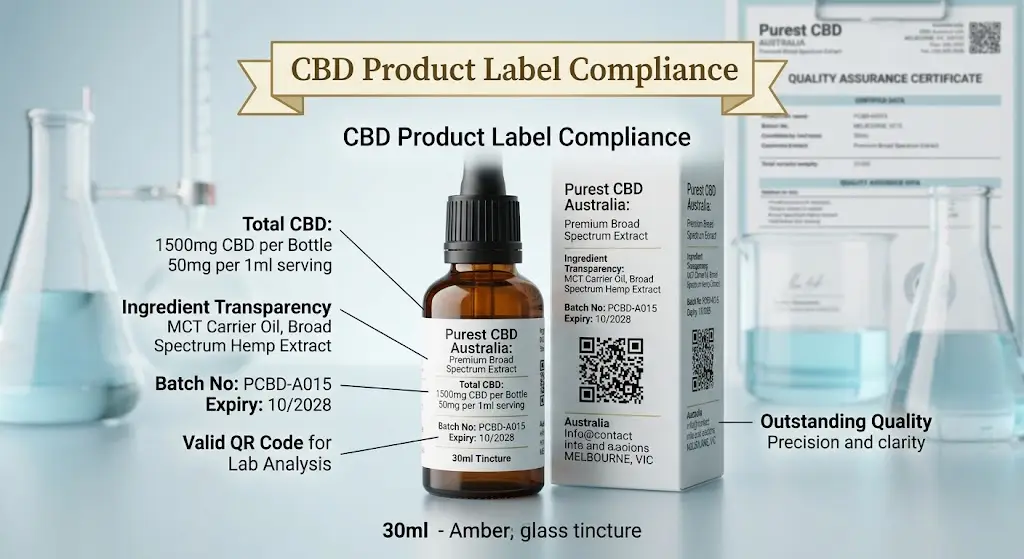
When evaluating hemp-derived formulations in the Australian market, understanding CBD Product Label Compliance is essential for verifying product authenticity, composition, and purity. Regulatory frameworks and industry standards mandate that product packaging accurately reflects chemical contents, batch identifiers, and manufacturing details. For consumers and researchers alike, reviewing label specifications provides critical insight into how hemp extracts are processed, analysed, and distributed.
A comprehensive approach to labelling ensures transparency across all stages of production. From cannabinoid quantification to carrier oil selection, clear documentation protects consumers against inaccurate strength claims and undisclosed constituents. In this article, we examine the fundamental standards governing compliant labels and how third-party analytical testing validates packaging declarations.
Why CBD Product Label Compliance Matters for Consumers
Achieving total CBD Product Label Compliance is the cornerstone of consumer trust and quality assurance within the Australian botanical industry. Because raw hemp biomass contains diverse compound profiles—including cannabinoids, terpenes, and trace flavonoids—finished products must present clear and verifiable data on their exterior packaging.
Proper labelling serves multiple operational and safety functions:
- Accuracy in Concentration: Ensures that the declared milligram concentration matches independent laboratory findings within acceptable variance limits.
- Ingredient Traceability: Lists all active extracts, secondary cannabinoids, and carrier bases such as medium-chain triglyceride (MCT) oil or hempseed oil.
- Regulatory Alignment: Adheres to national guidelines established by regulatory bodies like the Therapeutic Goods Administration regarding clear packaging disclosure and safety information.
- Batch Consistency: Provides specific lot numbers that allow consumers to cross-reference products with third-party analytical certificates.
5 Essential Factors in CBD Product Label Compliance
To evaluate whether a hemp product meets professional quality benchmarks, consumers should look for five key structural elements on every label.
1. Precise Cannabinoid Quantification
Compliant packaging must explicitly state the total concentration of cannabidiol (CBD) expressed in milligrams per bottle and per serving unit (such as per millilitre). Furthermore, labels should indicate whether the formula utilises broad-spectrum extract, isolated CBD, or full-spectrum botanical material, allowing users to understand the precise cannabinoid matrix present.
2. Traceable Batch and Lot Numbers
Every commercial batch must be assigned a unique lot identifier printed legibly on the container or box. This identifier links the individual bottle back to its specific production batch, raw material harvest, and corresponding Certificate of Analysis (COA). Batch traceability ensures accountability if analytical auditing or quality verification is required.
3. Complete Ingredient Transparency
A fully compliant label leaves no room for ambiguity regarding ingredient composition. All active and inactive components must be enumerated in descending order of predominance. This includes carrier oils, natural flavouring agents, and botanical terpenes, helping users identify potential allergens or dietary exclusions.
4. Expiry Dates and Storage Instructions
Cannabinoid compounds can undergo oxidative degradation when exposed to light, heat, or atmospheric oxygen over extended periods. Compliant labels clearly display manufacture dates, expiration timelines, and optimal storage recommendations (such as storing in a cool, dark place) to maintain stability throughout shelf life.
5. Laboratory Verification Links and QR Codes
Modern compliance standards increasingly feature accessible QR codes or direct web URLs on packaging. These digital portals direct consumers straight to batch-specific third-party laboratory reports, enabling independent confirmation of cannabinoid potency, heavy metal screening, and pesticide analysis.
Navigating Botanical Product Labels in Australia
Understanding how to interpret technical packaging information allows buyers to distinguish high-quality hemp extracts from inferior formulations. When assessing labels, always cross-reference declared values against laboratory documentation available through the official Purest CBD Australia educational resource hub. Verifying batch numbers, testing dates, and solvent purity guarantees complete confidence in your botanical selection.
Frequently Asked Questions About CBD Product Label Compliance
What information must appear on a compliant CBD product label in Australia?
A compliant label must clearly specify total CBD content in milligrams, serving size dimensions, a complete list of active and inactive ingredients, manufacturer details, batch or lot numbers, expiration dates, and recommended storage instructions.
How do I verify if label claims match the actual contents of the bottle?
You can verify label claims by scanning the QR code or visiting the URL provided on the packaging to access the batch-specific Certificate of Analysis (COA). The COA displays exact laboratory test results for cannabinoid profiles and purity metrics.
Why are batch numbers critical for CBD Product Label Compliance?
Batch numbers establish a direct chain of custody from cultivation and extraction to finished packaging. They ensure that every bottle can be audited against its specific analytical testing suite for safety and potency verification.
In conclusion, maintaining strict CBD Product Label Compliance is vital for fostering transparency, consumer safety, and botanical purity in the Australian marketplace. By understanding packaging requirements, reviewing ingredient profiles, and checking batch certificates, consumers can confidently select high-standard hemp formulations tailored to their requirements.
Recent Comments