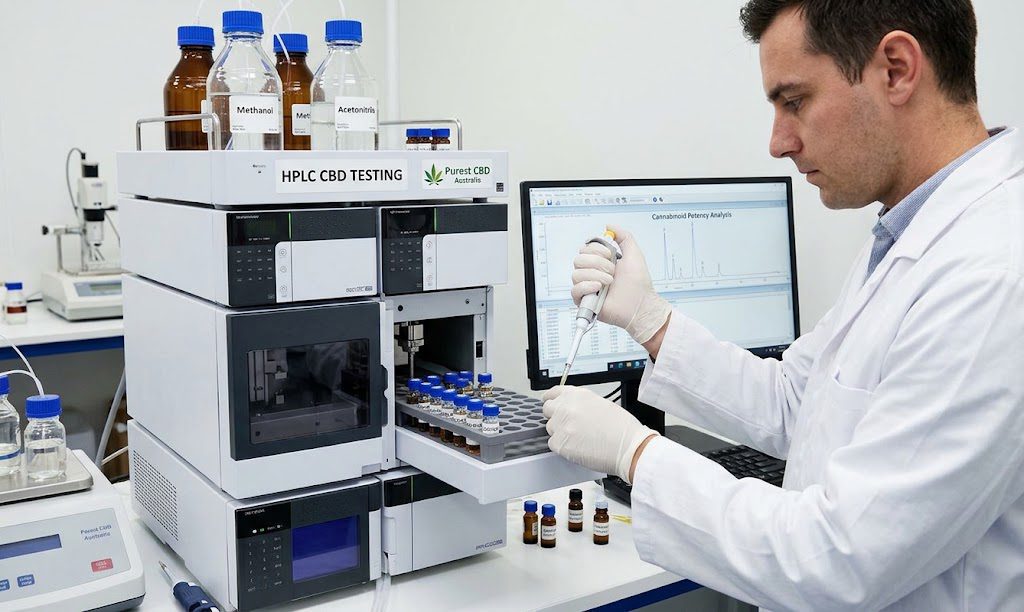
Ensuring the exact cannabinoid concentration and purity of hemp extract products requires precise laboratory methodologies. HPLC CBD Testing serves as the analytical gold standard across the Australian legal and commercial hemp sectors. High-Performance Liquid Chromatography (HPLC) allows technicians to separate, identify, and quantify individual cannabinoids without thermal degradation, offering superior accuracy compared to older testing mechanisms. For Australian consumers and industry professionals seeking verified product composition, understanding how modern laboratory analysis operates is fundamental to evaluating product standards and regulatory compliance.
Before any finished batch reaches distribution, comprehensive analytical testing validates that broad-spectrum formulations remain non-psychoactive while maintaining specified cannabinoid ratios. You can explore broader regulatory context and therapeutic frameworks through official guidance provided by the Therapeutic Goods Administration, while reviewing our comprehensive collection of educational articles on the Purest CBD Australia Blog.
What Is HPLC CBD Testing and Why Is It Necessary?
High-Performance Liquid Chromatography is an advanced chemical analytical separation technique. In HPLC CBD Testing, a liquid sample or dissolved hemp extract is pumped under high pressure through a column packed with solid adsorbent material. Each active compound within the sample interacts differently with the column packing, causing individual cannabinoids—such as Cannabidiol (CBD), Cannabigerol (CBG), Cannabinol (CBN), and Tetrahydrocannabinol (THC)—to separate based on their chemical properties and molecular weights.
Unlike Gas Chromatography (GC), which relies on heat to vaporise compounds and inadvertently converts acidic precursors like CBDA into neutral CBD during analysis, liquid chromatography operates at ambient temperature. This room-temperature separation preserves acid-form cannabinoids (such as CBDA and THCA) exactly as they exist in the raw botanical material, delivering a complete and accurate profile of the botanical extract.
1. Sample Preparation and Precise Extraction Protocol
The accuracy of high-performance analytical testing depends heavily on meticulous sample preparation. When hemp oil or extract arrives at a qualified testing facility, technicians execute a rigorous preparation protocol:
- Homogenisation: The batch sample is thoroughly blended to ensure even distribution of cannabinoids throughout the solvent matrix.
- Solvent Dissolution: A precise measured quantity of extract is dissolved in an HPLC-grade solvent, typically analytical-grade methanol or acetonitrile.
- Filtration: The solution is passed through a micro-porous membrane filter (typically 0.22 or 0.45 microns) to extract particulate matter that could clog chromatographic columns or distort light absorbance readings.
Flawless sample preparation prevents calibration drift, column fouling, and volumetric errors, laying a solid foundation for trustworthy analytical measurement.
2. Stationary Phase Column Selection for HPLC CBD Testing
The heart of liquid chromatography is the separation column. Modern laboratories utilise reverse-phase liquid chromatography (RPLC) equipped with specialized C18 stationary phase columns. In this configuration, non-polar analytical columns retain hydrophobic molecules like cannabinoids, while polar mobile phases carry compounds through at varying velocities.
Selecting optimised column lengths, pore sizes, and silica particle diameters ensures clear baseline separation between closely related cannabinoids. For instance, distinguishing Cannabidiol from trace Cannabichromene (CBC) or Delta-8 THC requires sharp chromatographic resolution. High resolution guarantees that peak overlap does not occur, providing exact milligram-per-millilitre calculations for every isolated cannabinoid.
3. Mobile Phase Optimisation and Isocratic vs Gradient Elution
The mobile phase in liquid chromatography consists of a liquid solvent mixture—frequently water and acetonitrile acidified with minor fractions of formic acid or ammonium formate to optimise peak shape. Laboratory technicians choose between two primary elution techniques:
- Isocratic Elution: The mobile phase composition remains constant throughout the run. This method is efficient for rapid target screening when measuring primary cannabinoids.
- Gradient Elution: The ratio of organic solvent is incrementally increased over time during sample execution. Gradient elution improves resolution when analysing complex, full-spectrum botanical extracts containing numerous minor phytocannabinoids, terpenes, and flavonoids.
Careful calibration of flow rates, temperature controls, and solvent ratios guarantees consistent retention times across consecutive testing runs.
4. Detection via Ultraviolet (UV/PDA) Spectrophotometry
As separated compounds exit the HPLC column, they flow directly into a specialized detector. Photodiode Array (PDA) or Ultraviolet-Visible (UV-Vis) detectors are most commonly employed for cannabinoid measurement because cannabinoids absorb ultraviolet light strongly at specific wavelengths (typically around 220 nm to 230 nm).
The detector measures light absorbance over time, generating a detailed chromatogram where each compound appears as a distinct peak. The position of each peak (retention time) confirms the identity of the specific compound, while the integrated area under the peak corresponds directly to its exact concentration against known reference standards.
5. Calibration Standards and Method Validation
To convert raw optical absorbance data into reliable numeric values, testing laboratories perform multi-point calibration using Certified Reference Materials (CRMs). These traceable standards are supplied by accredited chemical reference manufacturers and contain exact known concentrations of purified cannabinoids.
A multi-point linear calibration curve is established prior to each testing series. Automated software compares sample peak areas against these curves to generate final percentages and milligram readings. Regular quality assurance audits, matrix spikes, and blank control samples maintain strict laboratory accreditation and ensure batch-to-batch consistency.
Frequently Asked Questions About HPLC CBD Testing
How does HPLC CBD Testing differ from Gas Chromatography?
HPLC CBD Testing operates at room temperature, allowing for the direct separation and measurement of both acidic precursors (like CBDA) and neutral cannabinoids (like CBD) without thermal decarboxylation. Gas Chromatography heats samples, which naturally converts CBDA into CBD during analysis, making HPLC the preferred choice for detailed raw extract profiling.
Why is liquid chromatography important for Australian regulatory compliance?
Australian standards demand high quantitative accuracy regarding cannabinoid potency and strict verification of non-detectable or compliant THC levels. HPLC testing provides the high sensitivity and precision required to certify batch purity and ensure finished products align with legal specifications.
Can HPLC testing detect contaminants in hemp extracts?
While HPLC with UV detection is primarily optimised for cannabinoid profiling and potency analysis, modified HPLC-MS (Liquid Chromatography-Mass Spectrometry) systems or specialized GC-MS techniques are utilised to test for residual solvents, pesticides, mycotoxins, and heavy metals.
Summary of Analytical Excellence in Hemp Testing
In conclusion, rigorous HPLC CBD Testing remains essential for establishing quality assurance, precise formulation verification, and legal safety across all commercial hemp operations. By implementing standardised sample preparation, optimised C18 separation, precise UV/PDA detection, and traceable calibration standards, certified laboratory analysis ensures complete transparency for consumers and regulators alike.
Recent Comments